

Introduction
Latency plays a key role in digital performance. Today, users expect fast and smooth online experiences.
However, many businesses still face high latency. This often happens because of poor routing and heavy reliance on traditional IP transit.
As a result, performance drops and users become frustrated.
In this case study, we show how Internet Exchange (IX), combined with DCConnect solutions, can reduce latency and improve network performance.
The Problem: High Latency and Inefficient Routing
A growing digital company in Indonesia faced several issues.
First, users experienced slow response times.
Second, latency remained high even with enough bandwidth.
In addition, traffic was routed through international networks.
Because of this, user experience declined and performance became unstable.
The Root Cause
After further analysis, three main problems were found.
First, the company relied too much on international IP transit.
Second, there was no direct peering with local ISPs.
Finally, traffic routing paths were inefficient.
Even though the infrastructure was strong, the routing strategy was not optimized.
The Solution: Internet Exchange via DCConnect
To solve these issues, the company connected to an Internet Exchange using DCConnect’s Data Center Interconnection (DCI) solution.
With this approach, the company was able to improve routing and connectivity.
As a result, they could:
- Connect directly with multiple networks
- Keep local traffic within the region
- Reduce dependency on international routing
- Optimize traffic flow more efficiently
Implementation
The implementation process was simple and effective.
First, the company used a single port to connect to multiple ISPs.
Next, they established direct peering with content providers.
Then, they optimized routing for local traffic.
Finally, they scaled bandwidth based on demand.
Because of this setup, network performance became more stable.
The Results
After implementing Internet Exchange, the improvements were clear.
Latency was reduced by up to 40 percent.
In addition, load times became faster for local users.
Application performance also improved significantly.
At the same time, operational costs were reduced.
Overall, the user experience became much better.
Monitoring Performance with DCConnect Looking Glass
Reducing latency is important. However, measuring it is just as important.
For this reason, DCConnect provides a Looking Glass tool.
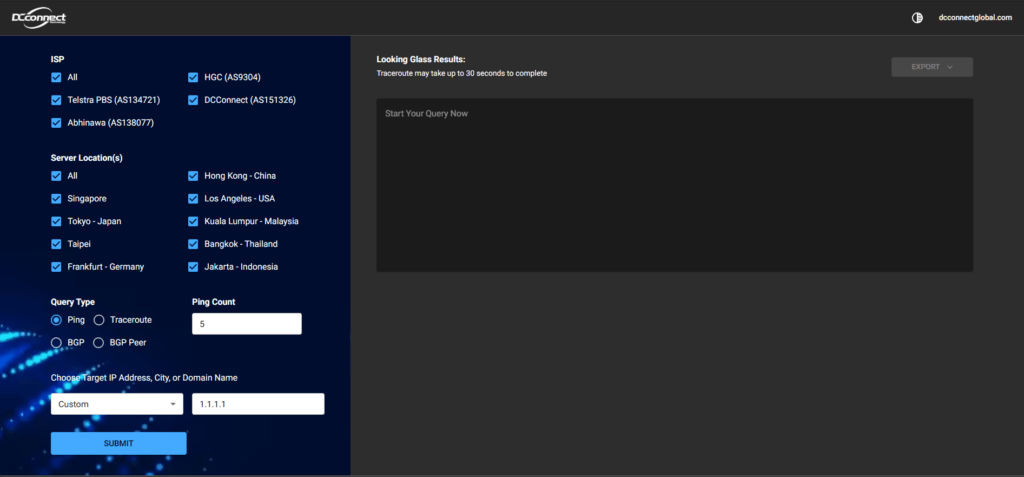
With this tool, businesses can monitor network performance in real time.
For example, users can:
- Check latency across different routes
- Run traceroute to see traffic paths
- Identify bottlenecks quickly
- Validate Internet Exchange performance
Why Looking Glass Matters
Without proper visibility, optimization becomes difficult.
However, with Looking Glass, businesses gain better control.
For instance, they can:
- Confirm traffic uses the shortest path
- Compare performance before and after IX
- Detect routing issues faster
- Maintain stable performance
Because of this, network decisions become more accurate.
Internet Exchange and Looking Glass for Full Optimization
Internet Exchange helps reduce latency. Meanwhile, Looking Glass helps verify it.
Therefore, both tools work best when used together.
Here is the process:
- Connect to Internet Exchange via DCConnect
- Optimize routing and peering
- Measure performance using Looking Glass
- Continuously improve network efficiency
As a result, businesses can maintain high performance over time.
Conclusion
Today, reducing latency is no longer optional. It is essential.
By using Internet Exchange, businesses can improve speed and efficiency.
In addition, DCConnect makes the process simple and scalable.
At the same time, Looking Glass provides the visibility needed to monitor performance.
Therefore, combining both solutions gives the best results.