
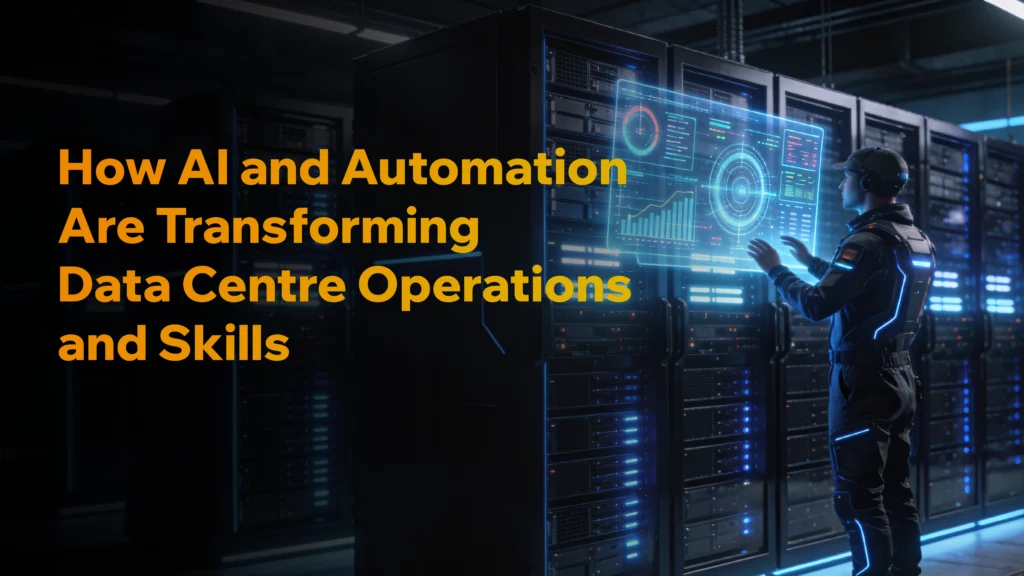
There was a time when running a data centre was as much about routine as it was about reliability. Engineers walked the floors, checked systems, responded to alarms, and kept everything running through discipline and experience. It was hands-on and reactive. But today, that rhythm is changing. Automation and AI are quietly transforming operations into something far more predictive, intelligent, and strategic.
Across modern data centres, work is no longer centered on constant monitoring. Instead, automation is taking over repetitive tasks—freeing people to focus on higher-value decisions. This shift isn’t about replacing humans; it’s about elevating them. The role is moving from “operator” to “decision-maker.”
How Automation Is Reshaping Roles
- From reactive to proactive: Systems now detect and prevent issues before they happen
- From manual tasks to insight-driven decisions: Engineers focus on analysis, not just execution
- From siloed work to integrated systems: Facilities, IT, and security platforms are converging
As a result, professionals are no longer just maintaining infrastructure—they’re actively improving it.
The New Skillset for Data Centre Professionals
The modern data centre engineer needs a broader toolkit:
- Technical foundations: Mechanical and electrical expertise still matter
- Digital fluency: Data analytics, automation tools, and software understanding
- Systems thinking: Ability to manage interconnected platforms and processes
This blend of skills turns engineers into orchestrators of complex environments rather than just operators of isolated systems.
Where Humans Make the Biggest Impact
As automation handles routine work, human focus shifts to areas that truly matter:
- Exception management: Handling edge cases and critical incidents
- Risk & compliance oversight: Ensuring governance, accountability, and trust
- Continuous improvement: Using insights to optimize performance over time
Instead of being everywhere, humans are now needed where they add the most value.
Measurable Impact on Operations
This transformation isn’t just conceptual—it delivers real, trackable results:
- Faster response times: Lower mean time to detect (MTTD) and resolve (MTTR)
- Greater efficiency: Improvements in energy usage (PUE/WUE)
- Reduced downtime: Predictive maintenance prevents failures
- Stronger resilience: More stable and reliable operations overall
These metrics provide tangible proof that automation is working.
A New Operating Model
What’s emerging is a fundamentally different way of running data centres:
- Integrated platforms replace fragmented tools
- Real-time data drives decision-making
- Automation handles scale with consistency
- Humans focus on strategy, governance, and innovation
It’s leaner, smarter, and built for growth.
Ultimately, automation and AI are not just transforming data centres—they are redefining the people behind them. With the right skills, operating model, and metrics, organizations can achieve higher resilience, better efficiency, and scalable growth. The future isn’t about fewer humans—it’s about more empowered ones, working alongside intelligent systems to build something stronger than ever before.