
Category: Internet

Blog

How to Improve WiFi Signal: Practical Tips for Faster and More Stable Internet

Slow WiFi can disrupt daily work, video calls, and access to cloud applications. In many cases, the issue is not only the internet speed itself, but also how the network is designed and configured. At DCConnect, we regularly analyze connectivity performance across different environments. This guide summarizes practical and proven steps to help improve WiFi signal quality in both homes and offices. 1. Optimize Router Placement Place your router: Physical obstacles significantly weaken wireless signals. 2. Minimize Wireless Interference Common interference sources include: Maintaining distance between these devices and your router can improve stability. 3. Use the Appropriate Frequency Band If your router supports dual-band: Choosing the right band depending on distance and usage can improve performance. 4. Select a Less Congested WiFi Channel In dense residential or office areas, overlapping WiFi channels reduce performance. WiFi scanning tools can help identify channels with lower usage so they can be configured manually. 5. Keep Router Software Updated Firmware updates often include: Restarting the router periodically can also help clear temporary issues. 6. Secure the Network Unsecured networks often experience reduced performance due to unauthorized usage. Basic security practices include: 7. Evaluate Router Capability Older routers may struggle with modern workloads, especially when many devices are connected. Routers supporting newer standards (WiFi 5 or WiFi 6) handle traffic more efficiently. 8. Extend Coverage for Larger Areas For larger spaces or multi-floor buildings: 9. Limit Unnecessary Connected Devices Every connected device consumes a portion of available bandwidth. Disconnecting unused devices can noticeably improve performance. 10. Use Wired Connections Where Possible For devices that require high stability, such as desktop computers or servers, wired Ethernet connections remain the most reliable option. 11. Configure Quality of Service (QoS) QoS allows prioritization of specific traffic types such as video conferencing or business applications, reducing disruptions during peak usage. 12. Verify Internet Connection Quality WiFi optimization is most effective when the underlying internet connection is stable. For reference, businesses typically use: These are common connectivity models used depending on operational requirements. Common WiFi Issues and Typical Solutions Issue Typical Approach Weak signal Adjust router placement, add access points Slow speed Use 5GHz band, reduce connected devices Dead zones Mesh or additional access points Unstable connection Update firmware, change channels Office congestion Network segmentation, bandwidth planning When Network Design Becomes Important As the number of users and applications increases, WiFi performance becomes closely tied to overall network architecture. Organizations often consider: These steps help maintain consistent performance as demand grows. Closing Notes Improving WiFi signal quality is usually the result of multiple small adjustments rather than a single change. With proper placement, configuration, and adequate internet capacity, most environments can achieve stable and reliable wireless connectivity.

Blog

Meet the Local Loop Network Built for Southeast Asia’s Digital Growth 

Southeast Asia’s digital economy is expanding at record speed. From hyperscale cloud platforms and AI-driven workloads to fintech, e-commerce, and content delivery, demand for fast, reliable, and scalable connectivity has never been higher.  That’s where our Local Loop Network comes in purpose-built to support the region’s next phase of digital growth.  At the core of the Local Loop Network are direct fibre connections to major data centres across Southeast Asia. By eliminating unnecessary hops and optimising routes, we deliver:  Whether you’re deploying cloud infrastructure or supporting AI workloads, performance and reliability are built in from day one.  Connectivity That Scales With You  With fibre networks rapidly expanding across Southeast Asia and cross-border connectivity stronger than ever, our Local Loop solutions are designed to scale alongside your business. You get:  From early-stage expansion to full hyperscale operations, the Local Loop Network adapts as your needs evolve.  Built for AI, Cloud, and Data-Heavy Workloads  Modern digital services demand more than basic connectivity. Our Local Loop Network is engineered to support:  With regional resilience built into the network, your operations remain stable—even as you scale across multiple markets.  Power Your Growth With Confidence  Whether you’re powering AI innovation, running cloud platforms, supporting fintech ecosystems, or delivering content at scale, the Local Loop Network gives you the connectivity foundation you can trust.   See how we can power your growth: https://www.dcconnectglobal.com/local-access-circuit/ 

Blog

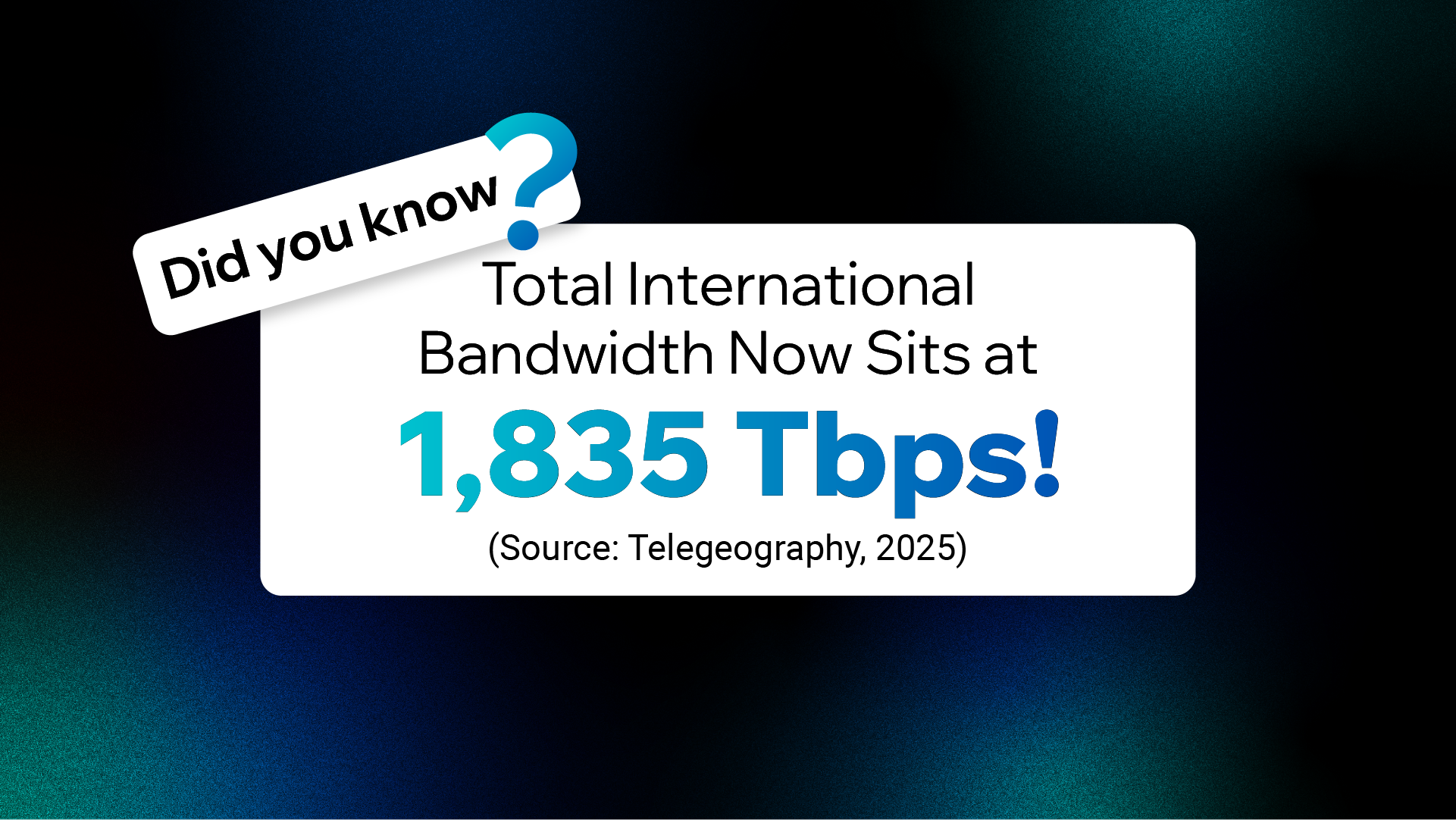
Did You Know?  Global Internet Bandwidth Has Reached 1,835 Tbps! 

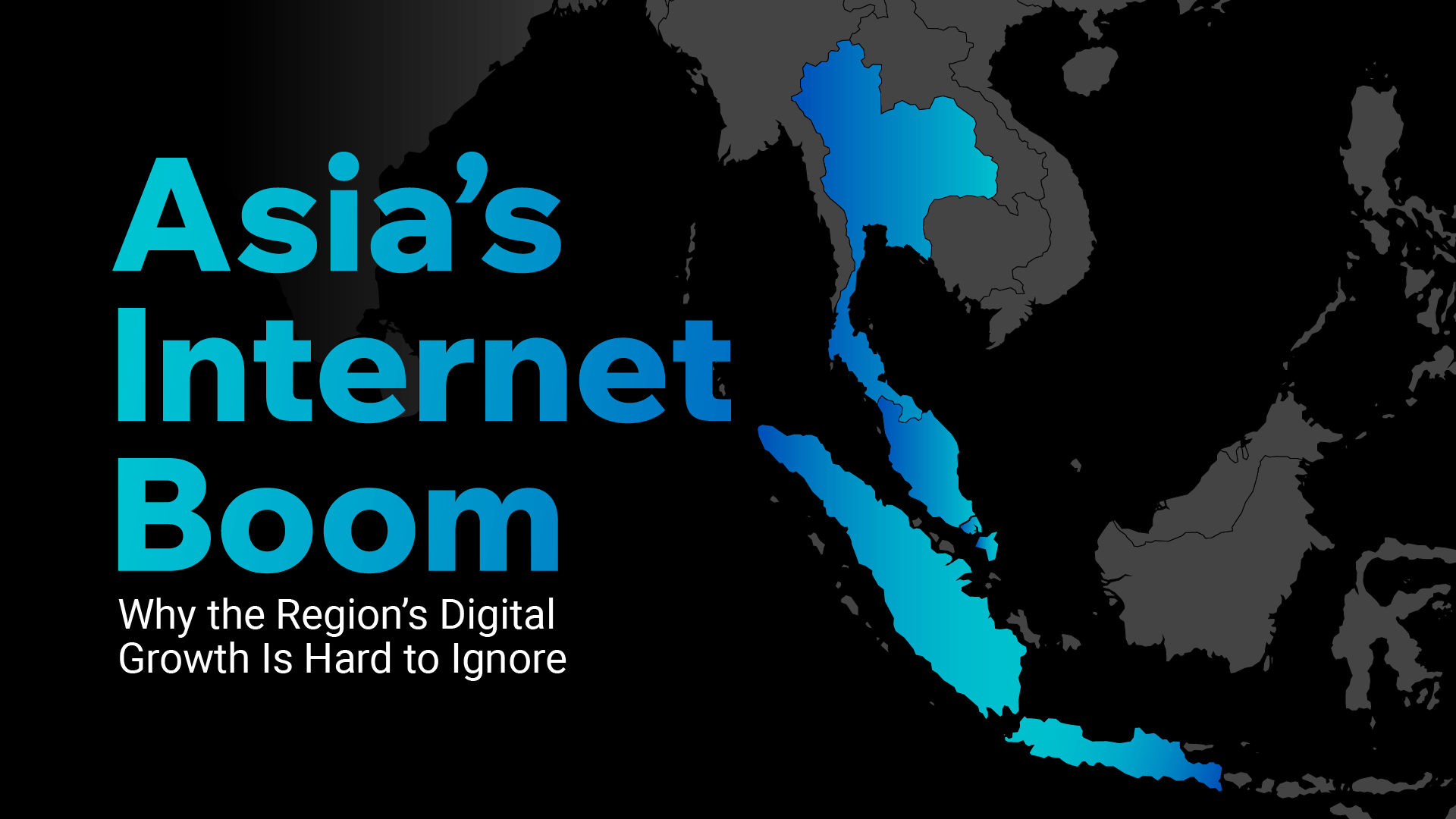
The world’s digital infrastructure is growing at an astonishing pace. According to TeleGeography (2025), total international internet bandwidth has now reached 1,835 terabits per second (Tbps), a milestone that highlights just how deeply connected our world has become.  But while this growth is global, Southeast Asia is stealing the spotlight.  Southeast Asia: One of the Fastest-Growing Digital Regions  Southeast Asia is now among the fastest-growing regions for international internet bandwidth, with growth estimated at 26–27% compound annual growth rate (CAGR). That’s not just a statistic it’s a reflection of how quickly digital life is expanding across the region.  So, what’s driving this surge?  Together, these factors are transforming Southeast Asia into a major digital hub.  What This Growth Really Means  While “26% annual bandwidth growth” may sound highly technical, the real-world impact is simple and powerful:  From online shopping and remote work to cloud gaming, video streaming, and yes endless TikTok scrolling the demand for fast, reliable internet has never been higher.  Looking Ahead  Asia’s digital growth story is far from over. With continued investments in infrastructure and an ever-growing online population, international bandwidth will only keep climbing.  For network providers, enterprises, and digital innovators, this isn’t just exciting—it’s a massive opportunity.  The future of connectivity is being built right now, and Asia is at the center of it. 

Blog

Stop Settling for Slow! Why Dedicated Internet Is the Game-Changer Your Business Needs 

We’ve all been there — staring at the screen, waiting… and waiting… and waiting.  Heard these before?  “Why is this page taking forever to load?”  “My video call just froze… again.”  “One more buffer and I’m giving up.”  “I’m downloading a file and it says 4 hours left. Seriously?”  If these sound painfully familiar, it’s time to face the truth: your internet connection is holding you back.  Switch to Dedicated Internet,  Because Every Second Counts  Whether you’re hosting virtual meetings, downloading large presentations, or sending time-sensitive emails, a sluggish connection doesn’t just slow you down — it costs you. But here’s the good news: the fix is simple. Dedicated Internet gives you the speed, reliability, and power your business deserves.  With 1:1 bandwidth, your internet connection is yours and yours alone. No sharing. No congestion. No “peak hour” slowdowns. Just pure, consistent, high-performance connectivity.  Get a free Dedicated Internet quote for your building at: https://webpricing.dcconnectglobal.com/ or talk to us today at: alliance@dcconnectglobal.com 

Blog

Instant Internet for B2B: Why “Fastest Provisioning” is the New Gold Standard

In the modern digital economy, agility is the ultimate currency. You can spin up a server in seconds. You can deploy code in minutes. You can onboard a remote team in hours. Yet, for many enterprises, the physical network remains a bottleneck. Traditional ISP contracts still operate on timelines from the 1990s: 60 to 90 days for site surveys, permits, and physical installation. This “provisioning gap” is no longer acceptable. Welcome to the era of Instant Internet B2B—where connectivity is as flexible, fast, and on-demand as the cloud itself. What is On-Demand Connectivity? On-Demand Connectivity transforms the network from a static utility into a dynamic service. It leverages Software-Defined Networking (SDN) to separate the control layer from the physical hardware. Because the underlying fiber infrastructure is already pre-connected and “lit” across major global hubs, provisioning a new dedicated line doesn’t require a technician to drive a truck to a data center. It simply requires a software command. This capability allows businesses to: The Business Case: Why Speed Matters More Than Ever Why are CIOs and IT Directors migrating to instant, on-demand networks? 1. Project-Based Agility Imagine a media company covering a major live event, or a construction firm setting up a temporary digital twin for a new site. They need massive bandwidth now, but only for three weeks. Traditional ISPs can’t handle this. On-demand connectivity allows them to spin up a 10Gbps pipe for the duration of the project and decommission it instantly when finished. 2. Disaster Recovery (DR) on Autopilot Paying for a massive standby line that sits idle 99% of the time is a waste of budget. With instant provisioning, companies can maintain a low-bandwidth “heartbeat” connection for backup. If the primary network fails, they can instantly “burst” the backup line to full capacity to handle the failover traffic, ensuring business continuity without the overhead. 3. Rapid Global Expansion Entering a new market? You don’t have time to wait months for local carriers to dig up the streets. Instant connectivity leverages existing global fabrics, allowing you to link your HQ to a new branch office or data center in a new country almost immediately. The Future is “Click-to-Connect” The user experience for enterprise networking is finally catching up to consumer expectations. The future isn’t about calling a sales rep and waiting for a quote. It is about logging into a dashboard, selecting Endpoint A (your office) and Endpoint B (the cloud), and clicking “Connect.” This Fastest Provisioning model reduces the “Time-to-Service” from months to minutes, removing the friction that slows down digital transformation.

Blog

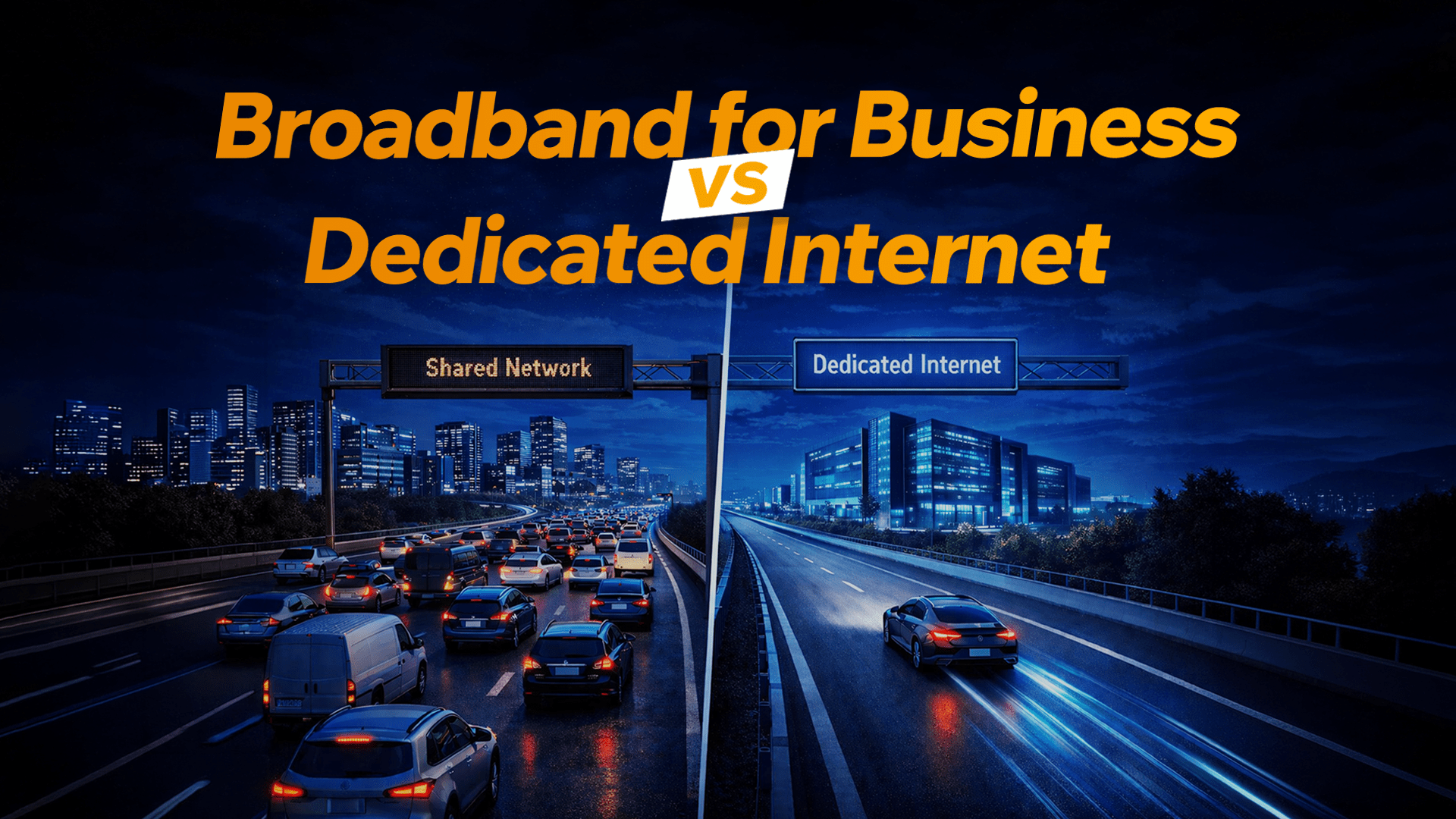
Broadband vs Dedicated Internet which one fits your business Needs

The internet is the lifeblood of modern business operations. Choosing the wrong type of connection can throttle your productivity and limit your growth. Business owners often face a critical choice: the budget-friendly Broadband Internet or the premium Dedicated Internet Access (DIA). This article provides an in-depth comparison of both services based on crucial business factors, helping you make the right decision for your company’s future. Understanding the Core Differences Before diving into the features, it’s essential to understand how these two types of connections operate. What is Broadband Internet? Broadband is a high-speed internet connection primarily designed for residential use or very small businesses (SOHO). What is Dedicated Internet Access (DIA)? Dedicated Internet Access is a premium, enterprise-grade connection exclusively for your business. Critical Comparison: DIA vs. Broadband for Business When evaluating which service to choose, you must weigh five critical factors: consistency, upload capacity, reliability, security, and cost. 1. Performance Consistency and Speed Feature Dedicated Internet (DIA) Broadband Internet Bandwidth Guaranteed and Dedicated (1:1). You always receive the speed you pay for. Shared (1:N). Speed is variable and drops during peak local usage. Speed Type Symmetrical. Upload speed equals download speed (100 Mbps up and 100 Mbps down). Asymmetrical. Download speed is typically much higher than upload speed (100 Mbps down and 10 Mbps up). Latency/Jitter Very Low and Predictable. Ideal for real-time applications like VoIP, financial trading, and video conferencing. Higher and Fluctuates. Can cause choppy video calls or poor voice quality. For businesses that rely heavily on cloud services, transferring large files, or frequent video collaboration, Symmetrical speeds and guaranteed bandwidth are non-negotiable advantages of DIA. 2. Reliability and Service Level Agreements (SLA) Reliability is arguably the biggest differentiator. How much does downtime cost your business? 3. Security A private connection offers a foundational layer of security. 4. Cost and Scalability The Verdict: Which One Should You Choose? The decision ultimately boils down to two factors: your dependency on the internet and your budget. Choose Broadband Internet If: Choose Dedicated Internet Access If: In the end, while Broadband may look cheaper, the true cost of unreliability (lost sales, reduced productivity) can make Dedicated Internet the more cost-effective strategic investment for any business committed to growth and operational excellence.

Blog

What is Instant Internet and How It Accelerates Business Deployment

In today’s fast-paced digital economy, businesses can’t afford to wait weeks or months for internet connectivity to be provisioned. Whether it’s launching a new branch, setting up a pop-up store, or scaling operations across regions, the demand for instant, reliable, and high-performance connectivity has never been greater.That’s where Instant Internet comes in — a next-generation solution designed to enable businesses to go online within minutes, not weeks. What is Instant Internet? Instant Internet is an on-demand internet service that allows enterprises to activate, scale, and manage bandwidth in real-time through a self-service portal or API integration. Unlike traditional broadband or leased lines that require manual provisioning, site visits, and long installation lead times, Instant Internet leverages software-defined networking (SDN) and automated provisioning to deliver connectivity instantly. Key Characteristics of Instant Internet: How Instant Internet Accelerates Business Deployment 1. Rapid Branch Deployment Opening a new branch or remote office used to take weeks due to manual provisioning and hardware setup. With Instant Internet, connectivity can be established within hours, enabling teams to start operations immediately. 2. Faster Cloud Integration Businesses that rely on cloud platforms like AWS, Azure, or Google Cloud can instantly connect to these environments via pre-integrated network paths, improving performance and reducing latency for mission-critical applications. 3. Agile Business Scaling Seasonal demand spikes or new project rollouts often require temporary bandwidth upgrades. Instant Internet lets IT teams adjust bandwidth in real time, ensuring network performance stays optimal without overpaying for unused capacity. 4. Simplified Management Through a centralized portal, businesses gain complete visibility and control over their connectivity — including monitoring usage, configuring QoS (Quality of Service), and automating billing reports. This helps streamline operations and reduce IT overhead. 5. Cost Efficiency Traditional internet deployments often involve upfront hardware costs, long-term contracts, and hidden fees. Instant Internet’s usage-based model reduces CAPEX, making it ideal for startups and enterprises that prioritize flexibility. Use Case Examples Conclusion Instant Internet represents a major shift in how enterprises consume and manage connectivity. By combining speed, flexibility, and automation, it eliminates traditional bottlenecks in network deployment and accelerates digital transformation across industries. Whether you’re a startup expanding globally or a large enterprise adopting hybrid cloud strategies, Instant Internet empowers your business to connect anywhere, anytime — instantly.

Blog

Instant Internet Service How to get High Speed Connectivity In Hours

In today’s digital-first world, waiting weeks or even days to get connected is no longer acceptable. Businesses and professionals need high-speed internet immediately—whether it’s for a new office setup, a critical event, or expanding to a new site. That’s where Instant Internet Service comes in. Unlike traditional internet provisioning, which often involves lengthy paperwork, manual installations, and back-and-forth with vendors, instant internet can be deployed within hours. Here’s how it works and why it matters. What is Instant Internet Service? Instant Internet Service is an on-demand connectivity solution that allows businesses to activate dedicated, high-performance internet almost instantly through a self-service portal or automated provisioning system. Think of it as the “cloud model” for internet access: scalable, flexible, and quick to activate. Key Benefits of Instant Internet 1. Rapid Deployment No more waiting for weeks. Services can be activated in just a few hours, sometimes minutes, with minimal human intervention. 2. Scalable Bandwidth Need more speed for peak hours or special projects? You can upgrade (or downgrade) your bandwidth on-demand, ensuring cost efficiency. 3. Reliable and Secure Unlike regular broadband, Instant Internet leverages enterprise-grade infrastructure, ensuring low latency, stable speeds, and strong SLAs (Service Level Agreements). 4. No Paperwork Hassle Everything is managed through a single digital dashboard—quotations, provisioning, monitoring, and billing. 5. Perfect for Short-Term Needs Whether for a business event, pop-up office, or temporary site, you can get enterprise-grade connectivity without long-term contracts. How to Get Instant Internet in Just a Few Steps Why Businesses Are Switching to Instant Internet From startups to global enterprises, businesses are realizing that speed is everything. Instant Internet isn’t just about convenience—it’s about staying competitive in an always-on digital economy. Instead of planning connectivity months ahead, you can now scale your network on demand, just like you do with cloud resources.

Blog

Broadband vs Dedicated Internet: Which One Fits Your Business Needs?

Reliable internet is the backbone of any modern business. Whether you’re a small startup or a large enterprise, choosing the right internet connection can directly impact productivity, customer experience, and long-term growth. The two most common options are broadband internet and dedicated internet access (DIA). But what’s the difference, and which one is right for your business? Let’s break it down. What is Broadband Internet? Broadband is a shared internet connection where multiple users utilize the same network capacity. It’s widely available and cost-effective, making it popular for homes and small businesses. What is Dedicated Internet? Dedicated Internet Access (DIA) provides businesses with exclusive bandwidth that is not shared with other users. This ensures consistent performance and reliability at all times. Broadband vs Dedicated Internet: Key Differences Feature Broadband Internet Dedicated Internet (DIA) Bandwidth Shared with other users Exclusive, not shared Speed May fluctuate during peak hours Guaranteed symmetrical speeds Reliability Best effort, no strict SLA SLA-backed, 99.9% uptime Cost More affordable Higher, premium service Use Cases Small businesses, light usage Enterprises, mission-critical operations Advantages of Broadband Internet Advantages of Dedicated Internet Which One Fits Your Business Needs? Conclusion When comparing broadband vs dedicated internet, the right choice depends on your business scale and connectivity requirements. Broadband is cost-effective and sufficient for light use, while dedicated internet is an investment in reliability and performance — essential for businesses that cannot afford downtime.

Blog

F1 Season Is Here!  Make Your Internet as Fast as a Race Car 

It’s Formula 1 season, and while the drivers are clocking jaw-dropping speeds on the track, you shouldn’t be lagging behind at your desk. Imagine if your internet performed like a finely tuned F1 car—zero lag, laser precision, and built to dominate the competition. That’s exactly what Dedicated Internet Access (DIA) offers. No traffic jams, no sharing lanes—just a direct, uncontested line between you and the digital finish line.  Unlike standard broadband, where bandwidth is shared with every neighbor binge-watching TV at the same time, DIA is like having your own private race track. You get symmetrical upload and download speeds, which means whether you’re uploading massive design files or joining mission-critical video calls, you’re moving at full throttle. Your data isn’t stuck behind a digital traffic cone, it’s flying down the straightaway at top speed.  Think of DIA as your pit crew’s secret weapon. When milliseconds matter—whether you’re trading stocks, running cloud-based applications, or hosting live streams, DIA keeps your business in pole position. It’s reliable, consistent, and doesn’t flinch under pressure. Just like an F1 car, it’s engineered for performance and control.  And let’s be honest, nobody wants a pit stop during a Zoom call or a laggy connection when closing a deal. With DIA, you don’t just stay connected you lead the pack. Whether you’re a small business aiming to scale or an enterprise that lives in the cloud, DIA is the turbo boost your connectivity deserves.  So as you cheer on your favorite F1 driver this season, ask yourself: is your internet keeping up? If not, it might be time to leave that shared connection in the dust and switch to Dedicated Internet Access. Because in the race for speed, reliability, and performance, DIA always takes the checkered flag.  Check the dedicated internat access in your building at: https://webpricing.dcconnectglobal.com/dia