

Southeast Asia’s digital infrastructure landscape is entering a major period of expansion. According to ARC Group, regional data center capacity is projected to triple by 2030, while the region’s generative AI market is expected to grow at a 50% CAGR to reach US$13 billion. As AI workloads, cloud adoption and data sovereignty requirements accelerate, SEA data center connectivity is becoming increasingly important.
More data center alone do not create a connected digital ecosystem. Businesses also need reliable and scalable connections between facilities, cloud platforms and enterprise networks. One of the most important corridors in this transformation is the growing connection between Singapore and Malaysia, particularly Singapore and Johor.
Why Southeast Asia’s Data center Market Is Expanding
AI is changing the requirements for digital infrastructure across Southeast Asia. Traditional enterprise applications already depend on data center and cloud platforms; however, AI workloads can require significantly greater computing capacity and higher-density infrastructure.
ARC Group projects that Southeast Asia’s data center capacity could reach between 5.2 GW and 6.5 GW by 2030, driven by traditional computing demand as well as the growing requirements of AI. ARC Group
Furthermore, sovereign cloud initiatives are creating additional demand for regional infrastructure. Businesses and governments increasingly need data to remain within specific jurisdictions, while enterprises are also looking for resilient architectures that can support business continuity.
As a result, the regional data center landscape is becoming more distributed.
Instead of relying on a single digital hub, businesses can increasingly operate across multiple locations. However, this model only works when those locations can communicate efficiently.
That is where connectivity becomes critical.
Singapore–Malaysia: A Strategic Digital Corridor
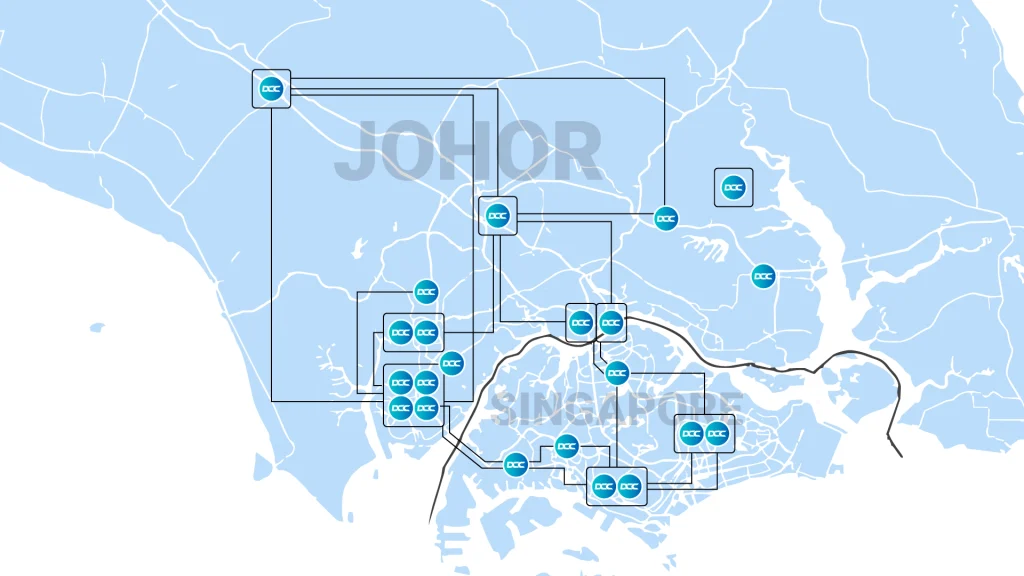
Singapore has long served as a major financial, technology and connectivity hub in Southeast Asia. Meanwhile, Johor is developing rapidly as a location for data center and other digital infrastructure.
The two markets therefore offer complementary capabilities.
Singapore provides access to an established digital ecosystem, international business networks and extensive connectivity. Johor, meanwhile, offers additional opportunities for large-scale digital infrastructure development.
The Johor–Singapore Special Economic Zone (JS-SEZ) is designed to strengthen the economic relationship between the two markets. Singapore’s Economic Development Board describes the zone as a framework that enables businesses to establish complementary operations across both countries and access the capabilities of each market.
Malaysia’s Ministry of Digital has also highlighted the role of the JS-SEZ in supporting data-centersupply-chain growth, as Johor continues to develop as a major data-center hub.
However, economic integration is only part of the equation.
For data-center operators, cloud platforms and enterprises, digital infrastructure must also be connected across the border.
Why SEA Data Center Connectivity Matters
A data center does not operate in isolation.
Applications may run across multiple facilities. Enterprise networks may connect to cloud platforms in another location. Disaster recovery infrastructure may sit in a separate country. AI workloads can also require access to large amounts of data distributed across different environments.
Therefore, the physical location of infrastructure is only one consideration.
The network connecting that infrastructure can be equally important.
Effective SEA data center connectivity can help businesses connect facilities across markets while supporting applications that depend on predictable network performance. This becomes particularly relevant when organisations operate hybrid-cloud or multi-cloud architectures.
For example, an enterprise could have its primary infrastructure in Singapore, additional capacity in Johor and cloud workloads distributed across several providers. A reliable interconnection strategy can help these environments operate as part of a broader digital architecture rather than as isolated sites.
From Data Centers to Connected Digital Ecosystems
The next stage of Southeast Asia’s digital infrastructure growth will not simply be about building more facilities.
Instead, the focus is increasingly shifting toward connecting those facilities.
Data centerinterconnection can link separate facilities through dedicated network services, allowing businesses to move data between locations and integrate distributed infrastructure.
DCConnect Global’s Data Center Interconnection service is designed to connect data center across its global network. The company provides connectivity options for organisations looking to interconnect distributed infrastructure across different markets.
This type of connectivity can be particularly relevant for organisations expanding across Singapore and Malaysia.
Instead of treating each facility as a standalone environment, businesses can build interconnected infrastructure that supports cloud access, application delivery, data replication and business continuity.
Building a More Connected Southeast Asia
Southeast Asia’s data-center market is moving toward a more distributed model. Singapore remains a critical digital hub, while Johor is becoming increasingly important for large-scale data-center development.
As these markets grow, SEA data center connectivity will become an increasingly important consideration for organisations managing distributed infrastructure.
Reliable data-center interconnection, cloud connectivity and regional network access can help businesses connect the different components of their digital environment.
For organisations planning their next stage of expansion, the question is no longer simply where to build or host infrastructure.
The next question is how to connect it.
With its data-center interconnection, cloud connectivity and broader regional network services, DCConnect Global provides connectivity options for businesses building distributed digital infrastructure across Southeast Asia. Contact us to get the details on: marketing@dcconnectglobal.com