
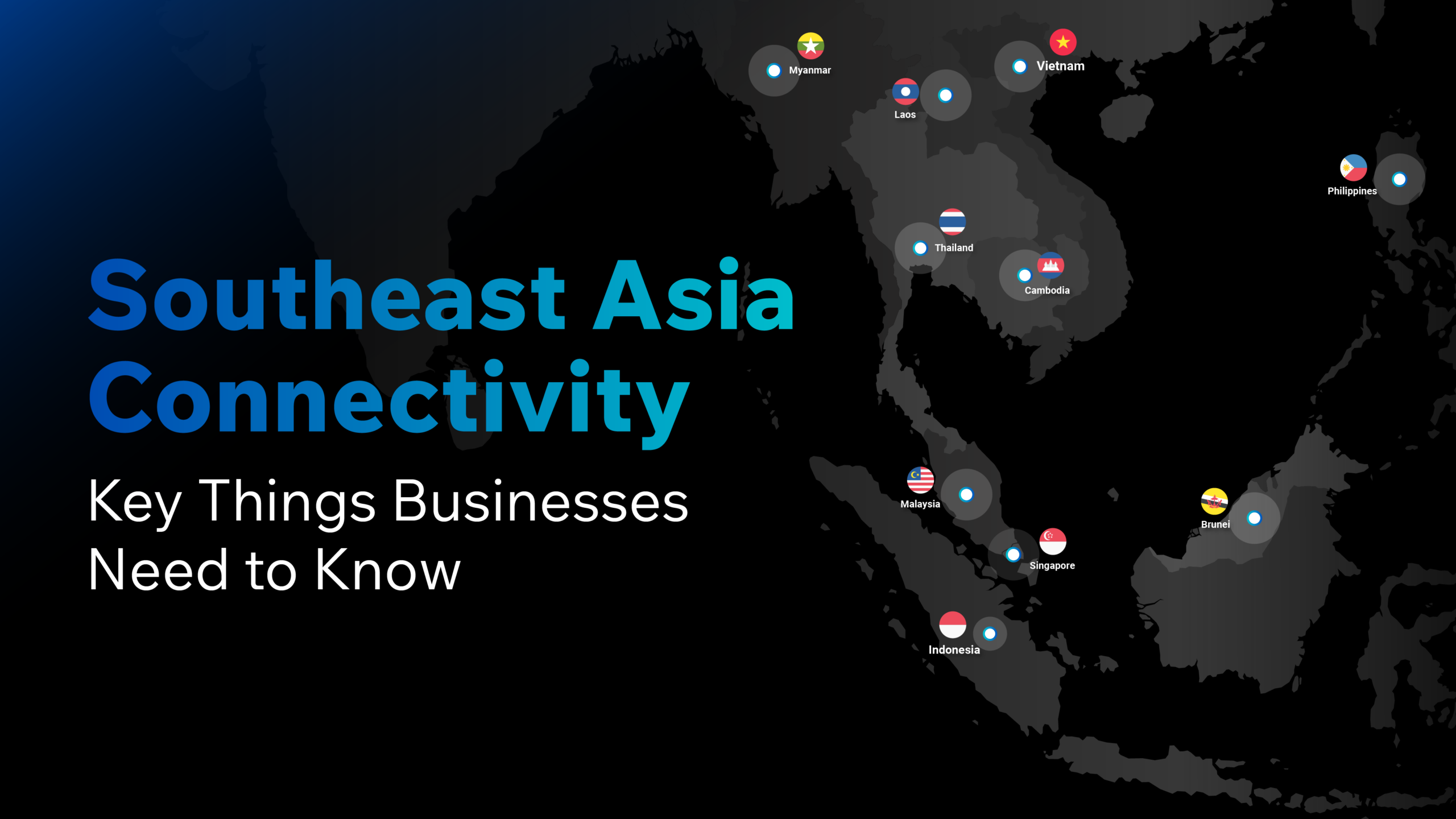
Southeast Asia Connectivity: Key Things Businesses Need to Know
The digital economy in Southeast Asia is growing at exceptional speed. Reported by Asean Guide For Sustainable Data Cener Development, By 2030, the region’s digital economy is expected to continue its rapid expansion, while data centres increasingly power artificial intelligence (AI), fintech, e-commerce, smart-city platforms and public-sector digitalisation. As a result, Southeast Asia connectivity has become a critical foundation for businesses looking to scale across the region. What Is Driving Southeast Asia Connectivity? Several major forces are accelerating investment in digital infrastructure. Furthermore, businesses are no longer looking only for individual data centres or cloud platforms; they need reliable, low-latency connectivity between multiple markets. Three key drivers stand out: AI and cloud computing, consumer digitalisation, and government-led digital transformation. 1. Artificial Intelligence and Cloud Computing AI is changing the way businesses use digital infrastructure. Generative AI, machine learning and high-performance computing require significantly more processing power, which in turn increases demand for high-density data centres and reliable network connections. AI workloads and sovereign-cloud strategies are therefore reshaping the region’s data-centre profile. Rack power densities that traditionally operated around 8–12 kW are expected to increase substantially, with some AI environments reaching significantly higher densities. Consequently, connectivity between data centres, cloud providers and enterprise locations has become just as important as physical computing capacity. Businesses need networks that can move large volumes of data quickly while maintaining predictable performance. 2. Consumer Digitalisation Southeast Asia’s young and increasingly digital population is another major driver. Fintech, e-commerce, online media, gaming and digital services continue to expand across the region. Therefore, companies require infrastructure that can deliver reliable and low-latency access to customers in multiple countries. Singapore remains an important digital hub. However, growth is also accelerating in Malaysia, Indonesia, Thailand and Vietnam. As digital services move closer to users, demand for edge and regional data-centre infrastructure is increasing beyond traditional hyperscale locations. This creates a more distributed digital ecosystem, connecting major hubs such as Singapore and Johor with emerging centres across Southeast Asia. 3. Government Policy and Digital Infrastructure Investment Government policy is also accelerating digital infrastructure development. Across Southeast Asia, national digital-economy strategies increasingly recognise data centres, cloud computing and telecommunications infrastructure as strategic assets. For example, Indonesia’s Making Indonesia 4.0 roadmap supports industrial digitalisation, while Vietnam’s National Digital Transformation Program promotes nationwide digital transformation. Similarly, Malaysia has incorporated digital and technology development into its New Industrial Master Plan 2030. Singapore, meanwhile, is strengthening its position as a sustainable digital hub through initiatives such as its Green Data Centre Roadmap. As a result, infrastructure investment is expanding across multiple markets rather than remaining concentrated in one country. Why Southeast Asia Connectivity Matters for Data Centres Building a data centre is only one part of creating a successful digital infrastructure strategy. Businesses also need connectivity between data centres, cloud environments, offices, internet exchanges and end users. Furthermore, international businesses often need to connect operations across several Southeast Asian markets while maintaining consistent performance and resilience. This is where Southeast Asia connectivity becomes particularly important. A regional connectivity strategy can help businesses: Therefore, connectivity should be considered alongside data-centre capacity, cloud strategy and cybersecurity rather than as a separate infrastructure requirement. Singapore–Malaysia: A Critical Connectivity Corridor One of the region’s most important connectivity corridors is the Singapore–Malaysia route. Singapore has established itself as a major digital and financial hub, while Johor is rapidly developing as a strategic location for data centres and digital infrastructure. Together, the two markets create a complementary ecosystem. The Johor–Singapore Special Economic Zone is expected to further strengthen economic links between the two sides. At the same time, the Johor Bahru–Singapore Rapid Transit System (RTS) Link is expected to improve physical connectivity between Johor Bahru and Singapore. However, physical connectivity is only one part of the story. Cross-border digital connectivity is equally important for businesses operating data centres, cloud platforms and distributed IT environments. As investment continues to expand in Johor, Singapore–Malaysia connectivity will play an increasingly important role in supporting the region’s digital economy. Connecting Southeast Asia Without Starting From Scratch The good news is that businesses do not have to build their regional network infrastructure from scratch. DCConnect Global provides established connectivity across key markets throughout Southeast Asia, helping businesses connect locations in Singapore, Malaysia, Indonesia, Thailand and Vietnam. Instead of managing multiple disconnected connectivity requirements in each country, businesses can establish a regional network foundation designed around their data-centre and business locations. Furthermore, this approach can make it easier to connect data centres, cloud environments and enterprise sites as companies expand into new markets. For businesses planning regional growth, the objective is not simply to have connectivity. Rather, it is to have the right connectivity architecture to support performance, scalability and business continuity. Contact DCConnect Global to explore the available connectivity options for your business and find the right route for your connectivity and infrastructure needs: https://www.dcconnectglobal.com/contact-us/