

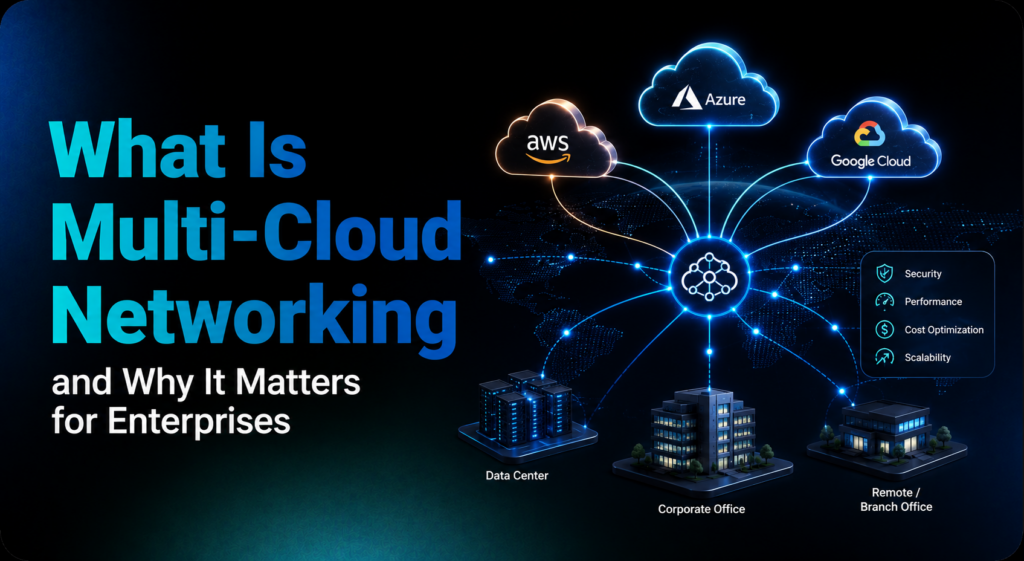
Multi-cloud networking is what happens when an enterprise uses two or more public cloud providers AWS, Azure, Google Cloud, or others inside one architecture, and needs consistent networking, security, and operations tying it all together. It’s no longer a niche strategy; it’s how most large organizations actually run their infrastructure today.
The appeal is obvious: no single point of failure, no vendor lock-in, and the ability to use each cloud’s unique strengths. The hard part is making it all work together without drowning in complexity.
Why Enterprises Choose Multi-Cloud
Cost Optimization and Avoiding Lock-in
Spreading workloads across providers gives businesses negotiating leverage and protects against being fully dependent on one vendor’s pricing or roadmap.
Flexibility and Compliance
Different regions and industries have different compliance requirements. Multi-cloud lets you match workloads to the provider that best satisfies data residency or regulatory rules in a given market.
Best-of-Breed Capabilities
Each cloud provider has areas where it leads — AI tooling, database services, global reach. Multi-cloud lets you use the strongest option for each workload instead of settling for one provider’s full stack.
The Real Challenges of Multi-Cloud Networking
| Challenge | Why It’s Hard |
| Complexity | Each cloud has its own networking model, APIs, and terminology |
| Latency | Traffic between geographically dispersed clouds adds delay |
| Security | More clouds means a wider attack surface to protect consistently |
| Cost visibility | Cross-cloud data transfer charges are easy to lose track of |
How to Make Multi-Cloud Networking Work
- Standardize connectivity — use a consistent network fabric instead of managing separate point-to-point links per cloud
- Centralize visibility — monitor traffic, cost, and performance across all clouds from one place
- Prioritize direct connections — bypass the public internet between clouds and your infrastructure wherever possible to cut latency and improve security
- Unify security policy — apply the same rules and access controls regardless of which cloud a workload runs on
Final Thoughts
Multi-cloud networking done well gives you resilience and negotiating power. Done poorly, it’s a tangle of point-to-point connections, inconsistent security, and surprise egress bills. The difference usually comes down to the network layer tying everything together.
DCConnect Global’s Multi Cloud Networking service connects your infrastructure directly to 300+ public clouds through a single SDN-orchestrated platform, simplifying exactly the kind of cross-cloud complexity that trips up most multi-cloud strategies.
FAQ
Is multi-cloud the same as hybrid cloud?
No. Hybrid cloud combines public and private cloud, while multi-cloud specifically means using multiple public cloud providers together. The two strategies can overlap but aren’t the same thing.
Does multi-cloud networking increase costs?
It can, especially around cross-cloud data transfer fees, if not managed carefully. A well-designed network layer with direct connections can significantly reduce these costs compared to routing everything over the public internet.
How many clouds is “multi-cloud”?
Technically two or more, though most enterprises running a genuine multi-cloud strategy actively use three or more providers for different workloads, regions, or compliance needs.