

For years, telecom operators quietly laid the foundation of the digital world. They built the invisible highways—fiber networks, mobile towers, and global connectivity—that made everything else possible. Every message sent, every video streamed, every app downloaded traveled across infrastructure they designed and maintained. And yet, as the digital economy exploded, much of the value created on top of those networks flowed elsewhere. Cloud giants and digital platforms scaled rapidly, capturing the spotlight—and the profits—while telecom operators remained in the background.
Over the past decade, data has grown at an astonishing pace, expanding not just steadily but exponentially. Smartphones became extensions of ourselves, video turned into the default language of the internet, and social media reshaped how we connect and communicate. Each innovation added more weight to the networks beneath. Telecom operators rose to the challenge, upgrading to 4G, then 5G, continuously expanding capacity. Still, despite carrying the load, they often found themselves in a position where growth in traffic did not translate to growth in value.
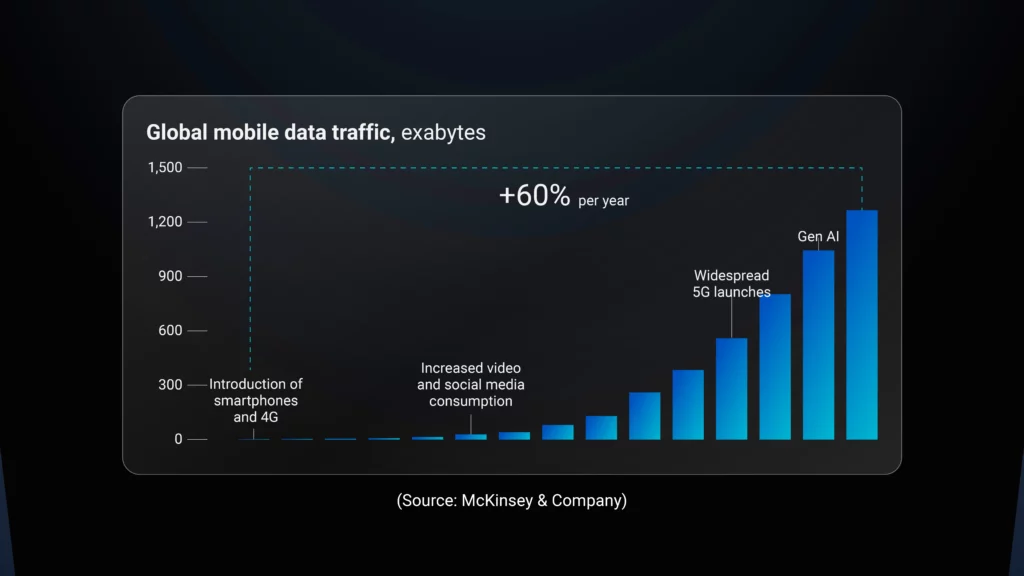
Now, a new wave is forming—one that feels different. Artificial intelligence is not just another application riding on top of the network; it is reshaping the very nature of how data is created, processed, and consumed. AI doesn’t simply require connectivity—it demands proximity, speed, and intelligence within the infrastructure itself. Suddenly, the network is no longer just a pipe. It becomes part of the product.
AI workloads are unlike anything telecom systems have handled before. They require ultra-low latency, where milliseconds matter. A delay that might go unnoticed in video streaming becomes critical when powering real-time AI decisions—whether in autonomous systems, smart cities, or industrial automation. This shifts the center of gravity closer to the edge, where telecom operators already have a powerful, distributed presence. What was once a limitation—being infrastructure-heavy—now starts to look like an advantage.
Consumers, too, are raising the bar. AI is quickly becoming embedded in everyday experiences—from personalized recommendations to intelligent assistants that anticipate needs. But users don’t think about latency, compute, or data routing. They simply expect things to work instantly and seamlessly. Meeting those expectations requires intelligence built directly into the network layer, not just layered on top of it.
This is why AI infrastructure represents more than just a technological upgrade—it is a strategic turning point. For telecom operators, it’s a rare second chance to move up the value chain. Instead of watching innovation happen above them, they can become active participants in shaping it. By combining connectivity with compute, data, and AI capabilities, they have the opportunity to redefine their role in the digital ecosystem.
The highways have already been built. Now, the question is who will control the traffic, the services, and the intelligence that flows through them. In the age of AI, infrastructure is no longer just the foundation—it is the opportunity.