Tag: Data Center Interconnection

Singapore Johor Connectivity
Blog

Singapore Johor Connectivity: Powering the AI Data Center Boom 

Singapore Johor connectivity is becoming increasingly vital as demand for artificial intelligence (AI), cloud computing, and hyperscale data centers accelerates across Southeast Asia. As reported by The Business Times, submarine data cables connecting Asia and the wider world converge in Singapore and extend directly toward Johor. Consequently, this strategic proximity creates tremendous opportunities for ultra-low-latency connectivity, supporting advanced computing and digital services for regional and international markets. Furthermore, Singapore and Johor offer highly complementary advantages in digital infrastructure development. While Singapore serves as an established international connectivity hub, Johor continues to attract massive interest as a premier location for data center expansion. However, capturing this opportunity requires far more than physical data center capacity alone. Specifically, enterprises also require resilient fiber infrastructure, diverse network routes, and reliable cross-border connectivity. How DCConnect Supports Singapore–Johor Connectivity DCConnect Global delivers specialized infrastructure and connectivity solutions engineered to support network expansion, data center interconnection, and greater route diversity across Southeast Asia. 1. Dark Fiber We provide dedicated fiber infrastructure delivering high-capacity connectivity between data centers, network hubs, and strategic locations. Consequently, this architecture supports demanding network requirements and seamless future infrastructure expansion. 2. Campus Duct Infrastructure Our robust duct infrastructure supports rapid fiber deployment and connectivity planning for hyperscale and AI data center campuses. Moreover, it helps operators accommodate surging interconnection requirements efficiently. 3. Terrestrial & Subsea Routes We operate extensive regional fiber routes linking key Southeast Asian markets and international gateways through integrated terrestrial and subsea infrastructure. Furthermore, these routes receive full support from strategic cable landing facilities. 4. Alternative Fiber Corridors DCConnect’s Right-of-Way (RoW) along major highways and state roads unlocks opportunities to develop alternative fiber corridors. As a result, organizations can improve route diversity and build far more resilient network architectures. Connecting the Next Generation of AI Infrastructure As Singapore and Johor continue to expand their digital infrastructure ecosystems, high-speed connectivity will play a decisive role in linking data centers, international networks, and emerging AI workloads. DCConnect Global powers this evolution through resilient terrestrial and subsea connectivity infrastructure across Southeast Asia. Specifically, our network is built to accommodate massive high-capacity transmission and demanding enterprise requirements. Discover how DCConnect Global can support your next data center or regional connectivity expansion today: https://www.dcconnectglobal.com/contact-us/

Southeast Asia Regional Connectivity
Blog

Southeast Asia Regional Connectivity: Powering Digital Growth 

Southeast Asia regional connectivity is becoming increasingly important as the region’s digital economy expands. Growing investments in AI, cloud computing, and hyperscale data centers are driving demand for greater network capacity and interconnected digital infrastructure.  According to the e-Conomy SEA 2026 report, Southeast Asia’s digital economy is expected to grow by 17% in 2026. Furthermore, Cushman & Wakefield reports that Asia Pacific’s data center pipeline reached 26.5 GW in the first half of 2026, with Southeast Asia accounting for around half of the capacity under construction.  As a result, reliable connectivity between data centers, network hubs, and international destinations is essential to supporting the region’s next wave of digital growth.  How DCConnect Global Powers Southeast Asia Connectivity  DCConnect Global supports businesses and digital infrastructure providers with connectivity solutions across Indonesia, Malaysia, Singapore, and Thailand.  1. Multi-Country Network Coverage  Access connectivity across four key Southeast Asian markets through one trusted partner. This simplifies cross-market network deployment and coordination while supporting regional business expansion.  2. Metro & Cross-Border Connectivity  From metro connections within major cities to cross-border routes, we support connectivity between data centers, network hubs, enterprise facilities, and international destinations.  3. Data Center Connectivity  Support connectivity and infrastructure planning for hyperscale and AI data centers, including connections between campuses and regional network ecosystems. Furthermore, our solutions address growing requirements for high-capacity data transmission and infrastructure interconnection.  Connecting Southeast Asia’s Digital Future  As the region’s digital infrastructure continues to expand, businesses need connectivity that can scale alongside their operations.  Whether you’re developing a hyperscale data center, expanding AI infrastructure, or connecting business locations across multiple markets, DCConnect Global helps bridge the distance between critical digital infrastructure.  Explore DCConnect Global’s connectivity solutions and discover how we can support your regional network requirements: https://www.dcconnectglobal.com/contact-us/ 

Johor Data Center Connectivity for AI
Blog

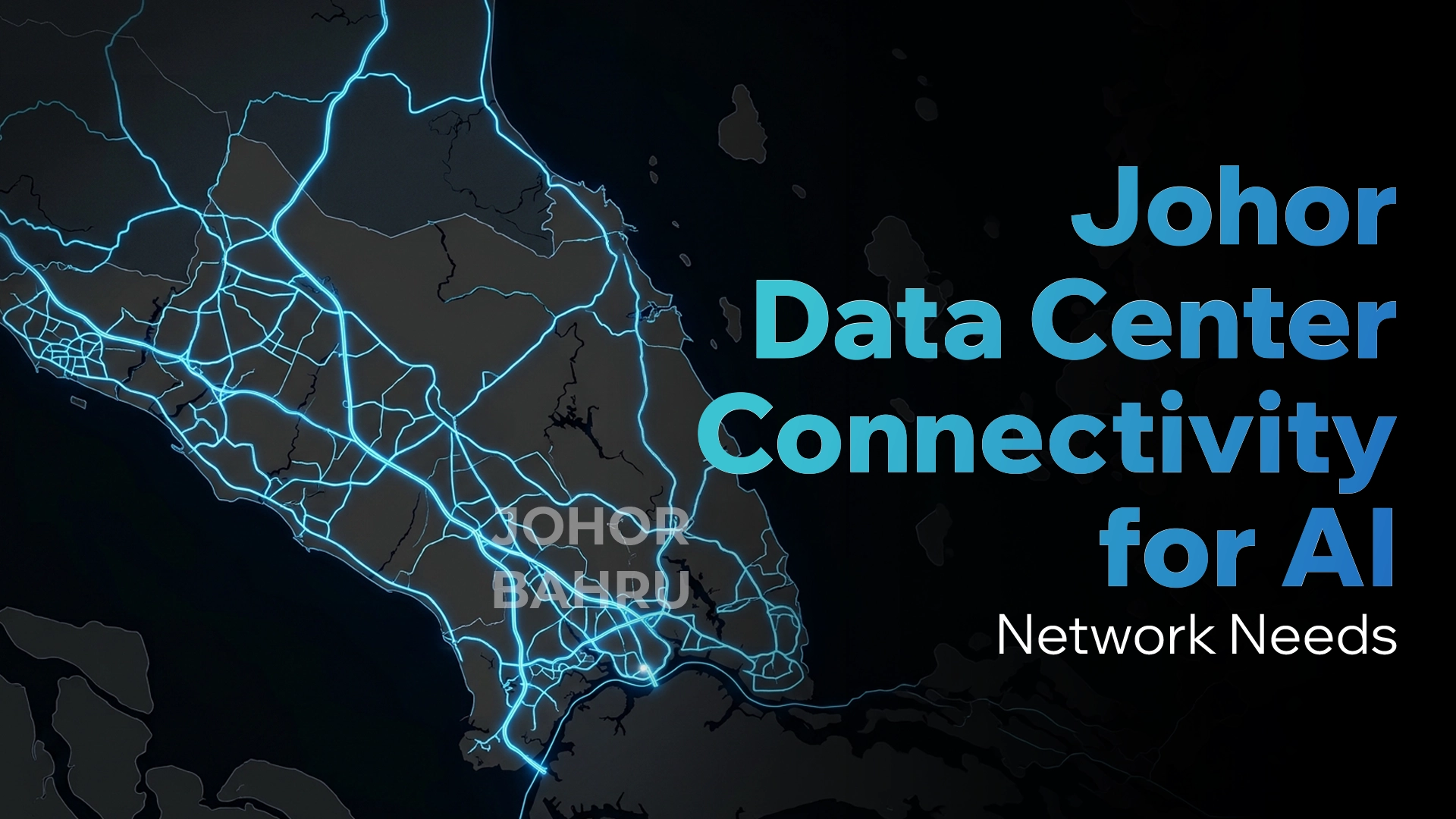
Johor Data Center Connectivity for AI: Network Needs 

Johor data center connectivity for AI is becoming increasingly vital. Specifically, Malaysia attracts massive investments in artificial intelligence, cloud computing, and high-performance computing infrastructure. Located directly adjacent to Singapore, Johor is rapidly developing into a premier data center market within Southeast Asia. However, constructing AI-ready facilities represents only part of the equation. Furthermore, modern enterprises require reliable, scalable connectivity to move massive datasets between data centers, computing campuses, cloud platforms, and regional business hubs. Malaysia’s AI Data Center Growth Creates New Connectivity Needs Malaysia’s digital infrastructure market continues to attract substantial capital investment. According to The Edge Malaysia, data center and cloud computing projects secured RM95.8 billion in approved investments during the first half of 2026. This figure represents nearly 44% of the country’s total approved investments during that timeframe. These impressive statistics reflect surging demand for advanced digital infrastructure, including heavy computing capacity required for complex AI workloads. Johor stands firmly at the center of this national development. Its close proximity to Singapore, rapidly expanding digital footprint, and growing data center ecosystem create incredible opportunities for operators and enterprises seeking regional compute capacity. Furthermore, as AI adoption accelerates, network planning must account for far more than conventional enterprise web traffic. Networks must support data-intensive AI workloads, seamless facility interconnections, and low-latency access to distributed cloud resources. Why AI Workloads Need High-Performance Connectivity Artificial intelligence infrastructure places entirely different performance demands on telecommunications networks compared to traditional enterprise software. AI model training involves massive datasets and continuous, high-frequency communication between distributed computing nodes. Meanwhile, inference services demand ultra-responsive connections to deliver instant results to end-users and client applications. Consequently, network performance becomes a critical consideration when organizations plan their AI deployments. Modern facilities frequently support GPU-as-a-Service, AI training and inference pipelines, automated AI factories, and high-performance computing (HPC) clusters. These heavy workloads require substantial data movement between specialized computing clusters and high-speed storage environments. Therefore, businesses must prioritize bandwidth capacity, ultra-low latency, route diversity, dynamic scalability, and absolute network reliability when designing their underlying connectivity. Moreover, organizations operating across multiple physical facilities often need to link separate data centers or technology campuses as part of a unified, distributed computing environment. A robust connectivity strategy built around these specific requirements ensures enterprises can scale their infrastructure smoothly as compute demand grows. Johor’s Growing Role in Southeast Asia’s AI Infrastructure Johor’s booming AI data center developments underscore the massive scale of infrastructure planned for Malaysia’s digital economy. W.Media reported that Racks Central is actively developing a massive 510 MW AI data center campus in Johor, with cutting-edge GPU infrastructure scheduled across successive phases. Furthermore, Phase 1 remains on track to open soon. Project timelines and final operational capacities remain subject to standard commissioning workflows. As this complex infrastructure matures, robust connectivity linking local facilities and regional digital hubs becomes indispensable. For instance, data-center-to-data-center connections support seamless communication between separate facilities, while campus-to-campus links bridge infrastructure across neighboring sites. Additionally, reliable long-haul connectivity stretching to Kuala Lumpur, Cyberjaya, and Singapore helps enterprises tie their Johor operations into wider national technology ecosystems. The resulting network requirements will naturally vary depending on specific workloads and architectural designs. Therefore, enterprises should thoroughly assess their actual performance metrics, capacity thresholds, path resilience, and geographic needs prior to finalizing any network architecture. DCConnect empowers enterprises with diverse connectivity options engineered specifically to link remote data centers, technology campuses, and regional digital hubs. In Johor, our service portfolio includes data-center-to-data-center, campus-to-campus, and robust long-haul connections bridging Kuala Lumpur, Cyberjaya, and Singapore. This comprehensive approach enables businesses to orchestrate multi-site network connections rather than relying on a single, congested regional corridor. Furthermore, DCConnect’s specialized Singapore–Johor connectivity solutions provide a direct pathway for exploring high-performance links between these neighboring digital powerhouses. Simultaneously, the broader DCConnect Global Network offers a comprehensive view of international connectivity options, enabling organizations to evaluate ideal network arrangements tailored to specific site requirements, capacity goals, and resilience targets. Build Your AI Connectivity Strategy in Johor As Malaysia’s AI and data center ecosystem continues to expand, resilient connectivity remains the deciding factor in turning massive capital investments into usable digital capacity. Johor’s thriving data center landscape unlocks immense opportunities for enterprises, cloud providers, and technology innovators to unify computing resources across local campuses and regional markets. DCConnect delivers advanced data-center-to-data-center, campus-to-campus, and long-haul connectivity solutions linking Johor directly with Kuala Lumpur, Cyberjaya, Singapore, and the wider Southeast Asian network. Explore the DCConnect Global Network today or contact our engineering team to discuss your infrastructure requirements and develop a customized route solution for your AI deployment: https://www.dcconnectglobal.com/contact-us/

Johor Data Center Growth 2026
Blog

Johor Data Center Growth 2026: Driving Southeast Asia’s Digital Future 

Johor data center growth is accelerating rapidly. Consequently, Malaysia’s southern state is positioning itself as a vital digital infrastructure hub in Southeast Asia. According to Factory Hub 2026, Malaysia’s operational data center capacity is expected to double by the end of 2026. Furthermore, Johor currently maintains around 1,500MW of data center capacity actively under construction. What Is Driving Johor Data Center Growth? Johor’s expansion is not simply about adding raw server capacity. Instead, the state is transforming into a major economic and technology hub. This momentum is supported by its strategic geographic location, established infrastructure, and close proximity to Singapore. In just six months, developers added 160MW of new capacity, highlighting the incredible speed of the market. Furthermore, Johor is on track to become a massive 1GW data center market by the end of 2026. Consequently, this surge strengthens its position within the broader regional digital infrastructure landscape. One of the biggest advantages driving Johor’s expansion is its proximity to Singapore. Both territories are separated only by the Johor Strait, creating a natural opportunity for enterprises to bridge infrastructure across both locations. As a result, reliable Singapore–Johor connectivity is becoming increasingly critical. Data center operators, cloud providers, and enterprises require high-performance network links to move data seamlessly while supporting AI, cloud, and other data-intensive workloads. Therefore, robust connectivity is just as important as the physical data center buildings themselves. Building a Connected Data Center Ecosystem Johor’s growing data center capacity creates exciting opportunities for enterprises expanding their digital footprints across Southeast Asia. However, additional capacity requires dependable network infrastructure to link local facilities directly with Singapore and other regional hubs. DCConnect fully supports this expanding ecosystem through advanced Singapore–Johor connectivity solutions, helping enterprises establish scalable connections between these two pivotal markets. Furthermore, DCConnect powers this ecosystem with diverse routing options in Johor, including data-center-to-data-center, campus-to-campus, and long-haul connections to major digital centers like Kuala Lumpur, Cyberjaya, and Singapore. These solutions empower businesses to build scalable, high-performance networks across Johor and beyond. With connectivity services tailored for data centers, cloud environments, and enterprise networks, organizations can construct robust infrastructure supporting both current operations and future growth. Connect Johor With DCConnect As Johor’s data center ecosystem continues to scale, enterprises need flexible connectivity bridging local facilities across Malaysia and Singapore. DCConnect delivers scalable network solutions for data-center-to-data-center, campus-to-campus, and long-haul connectivity, directly linking Johor with primary digital hubs including Kuala Lumpur, Cyberjaya, and Singapore. Explore DCConnect’s network today to discover flexible connectivity options across Johor and Southeast Asia, or contact our team to discuss your specific infrastructure requirements and build a customized route solution for your business: https://www.dcconnectglobal.com/contact-us/

Singapore Connectivity: Subsea Cables & Regional Links 
Blog

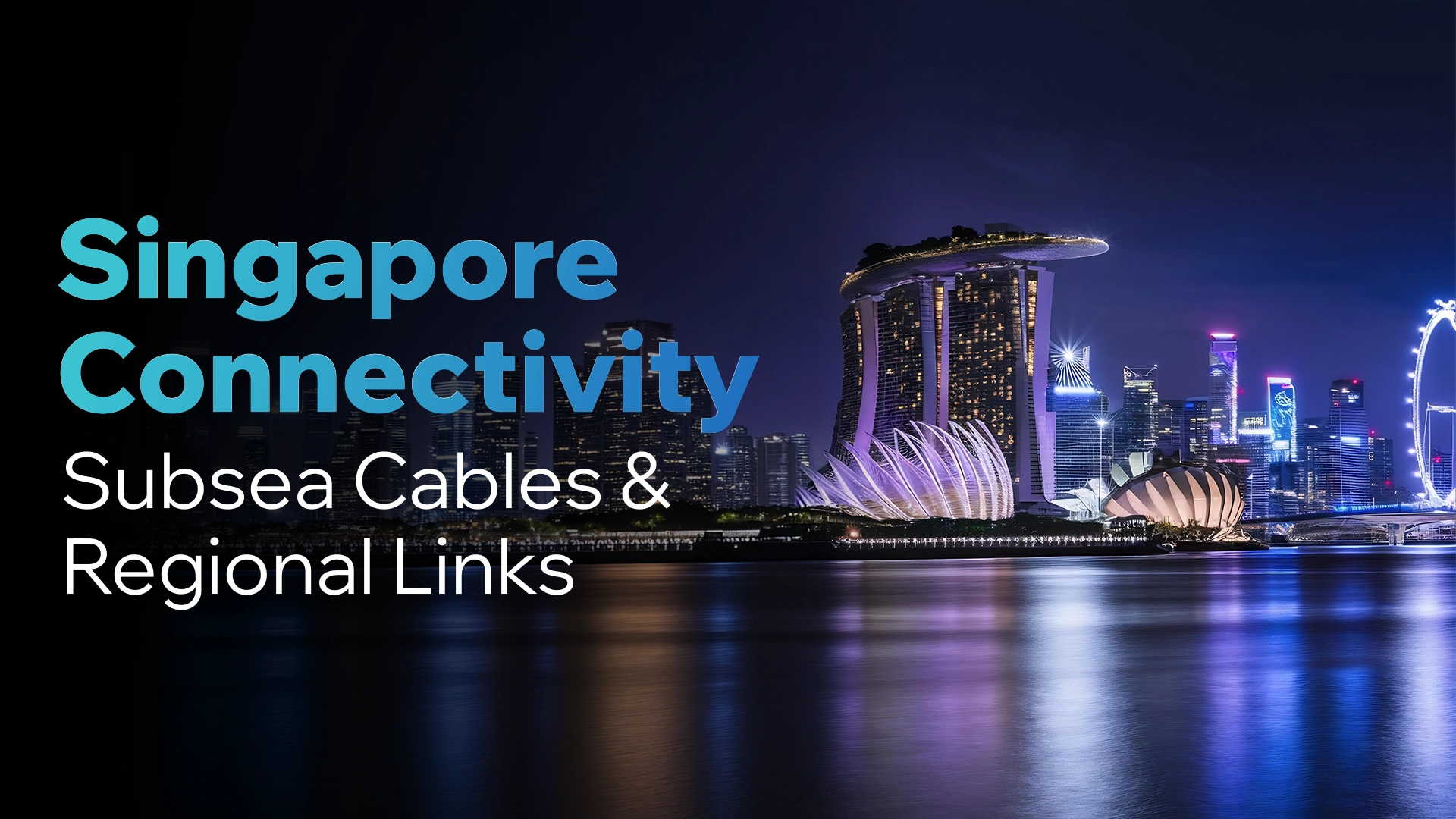
Singapore Connectivity: Subsea Cables & Regional Links 

Singapore connectivity plays a critical role in Southeast Asia’s digital infrastructure. As businesses expand across the region, reliable connections between Singapore, Malaysia and Indonesia are becoming increasingly important for data centers, cloud platforms, enterprise networks and digital services.  Singapore is also a major hub for international subsea cables. These systems form a critical part of the global internet infrastructure, carrying vast amounts of data between countries and continents. According to CNA, subsea cables can carry more than 99 per cent of the world’s data traffic, making them essential infrastructure for modern digital economies.  Why Singapore Connectivity Matters  Singapore’s strategic location and extensive digital infrastructure make it an important gateway into Southeast Asia. For companies operating across the region, however, connecting to Singapore is only part of the requirement.  Businesses increasingly need to connect Singapore with neighbouring markets such as Malaysia and Indonesia. Therefore, access to data center and network infrastructure across these markets can help enterprises build more flexible and resilient regional architectures.  This is particularly relevant as data center development continues across Singapore, Johor, Batam and Jakarta.  Singapore Subsea Cable Infrastructure  A Singapore subsea cable provides the physical foundation for high-capacity international data transmission. These fibre-optic systems connect Singapore with other major digital hubs, supporting everything from cloud applications and financial transactions to video, enterprise communications and AI workloads.  Singapore continues to invest in digital connectivity and subsea cable infrastructure. Its Digital Connectivity Blueprint identifies submarine cable infrastructure as an important part of maintaining Singapore’s position as a global digital hub. IMDA Digital Connectivity Blueprint  However, the cable itself is only one part of the connectivity ecosystem. Businesses also need reliable network connections from data center and cable landing points to their offices, cloud environments and regional infrastructure.  Singapore–Malaysia Connectivity  The Singapore–Malaysia corridor is becoming increasingly important as Johor develops into a major data center market.  Its proximity to Singapore allows businesses to deploy infrastructure in Johor while maintaining connectivity to Singapore’s established digital ecosystem. As a result, Singapore–Malaysia connectivity can support companies that need to connect data center , cloud platforms and enterprise networks across the border.  DCConnect provides carrier-neutral connectivity between Singapore and Malaysia, including access to key data center locations. Its network supports scalable bandwidth and connectivity options designed for businesses that need reliable regional infrastructure.  For enterprises distributing workloads across Singapore and Johor, this connectivity can support cloud access, disaster recovery, data center interconnection and regional expansion.  Singapore–Indonesia Connectivity  The Singapore–Indonesia corridor is also developing rapidly. The Nongsa–Changi subsea cable provides a direct connection between Singapore and Batam, strengthening the digital relationship between the two locations.  Batam’s proximity to Singapore makes it increasingly relevant for data center and digital infrastructure serving Indonesia and the wider region. At the same time, businesses operating in Jakarta can benefit from connectivity that links Indonesia’s major commercial center with Singapore’s international network ecosystem.  DCConnect provides connectivity across Indonesia, including Jakarta, while its regional network connects businesses across Singapore, Malaysia and Indonesia.  Connect Singapore, Malaysia and Indonesia With DCConnect  For modern enterprises, connectivity needs to extend beyond a single country. A business may need to connect a Singapore data center with facilities in Johor, Batam or Jakarta while also reaching cloud platforms and other regional locations.  DCConnect helps simplify this process with carrier-grade, scalable connectivity across Southeast Asia. Its network provides access to data center and cloud platforms across multiple markets, giving businesses the flexibility to build connectivity around their operational requirements.  Whether you need Singapore connectivity, Singapore subsea cable access, Singapore–Malaysia connectivity or Singapore–Indonesia connectivity, a reliable regional network can provide the foundation for digital growth.  Accelerate your digital growth with DCConnect. Backed by carrier-grade infrastructure, DCConnect provides the speed, reliability and seamless provisioning needed to connect with Singapore and Malaysia’s premier data center, while extending connectivity across Indonesia and the wider Southeast Asian region.  Explore the DCConnect Global Network to discover regional connectivity options on: https://www.dcconnectglobal.com/our-network/  or contact us to discuss your specific connectivity requirements and get a customised route solution for your business: https://www.dcconnectglobal.com/contact-us/ 

SEA Data Center Connectivity: Why Singapore–Malaysia Matters 
Blog

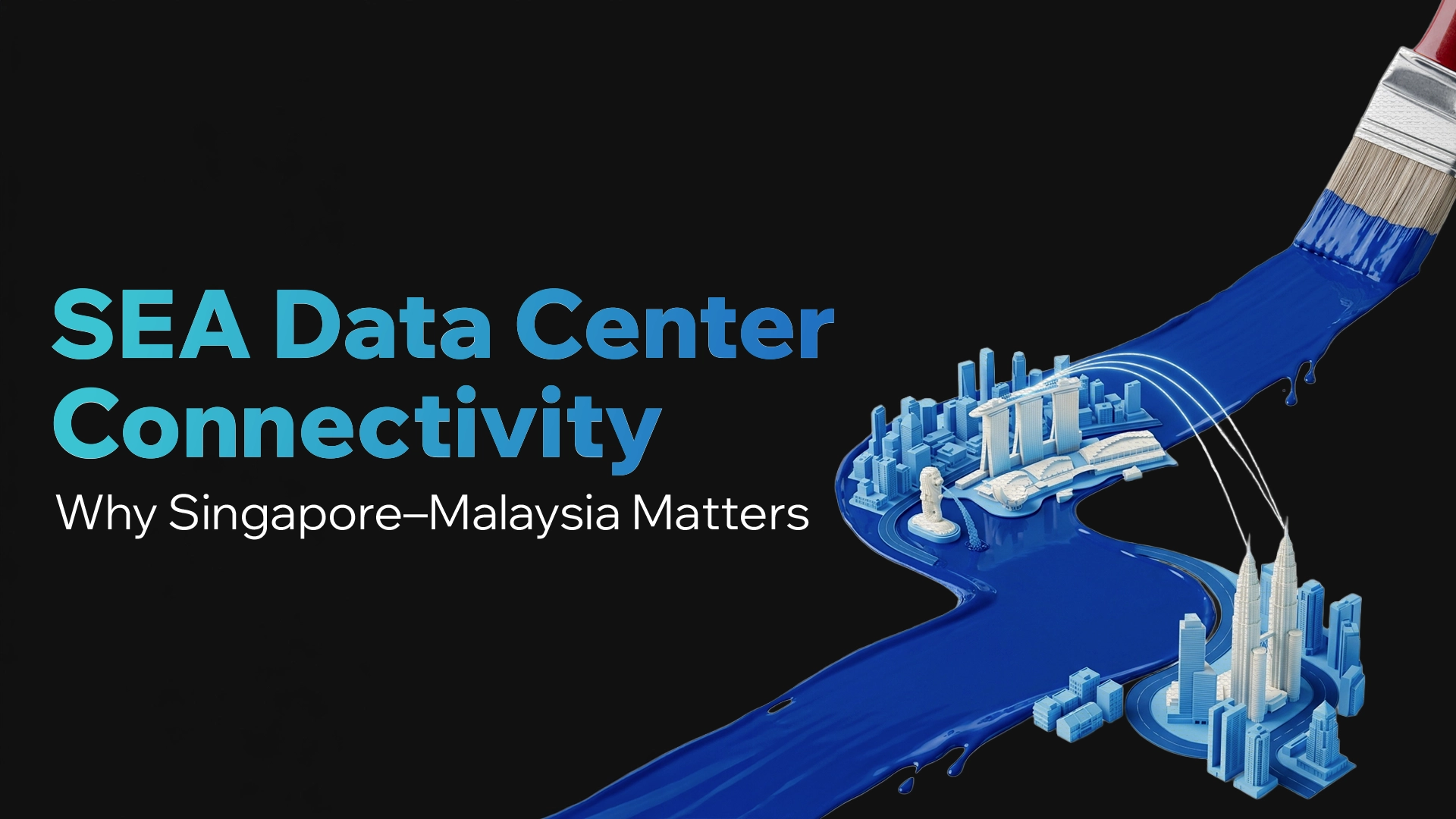
SEA Data Center Connectivity: Why Singapore–Malaysia Matters 

Southeast Asia’s digital infrastructure landscape is entering a major period of expansion. According to ARC Group, regional data center capacity is projected to triple by 2030, while the region’s generative AI market is expected to grow at a 50% CAGR to reach US$13 billion. As AI workloads, cloud adoption and data sovereignty requirements accelerate, SEA data center connectivity is becoming increasingly important.  More data center alone do not create a connected digital ecosystem. Businesses also need reliable and scalable connections between facilities, cloud platforms and enterprise networks. One of the most important corridors in this transformation is the growing connection between Singapore and Malaysia, particularly Singapore and Johor.  Why Southeast Asia’s Data center Market Is Expanding  AI is changing the requirements for digital infrastructure across Southeast Asia. Traditional enterprise applications already depend on data center and cloud platforms; however, AI workloads can require significantly greater computing capacity and higher-density infrastructure.  ARC Group projects that Southeast Asia’s data center capacity could reach between 5.2 GW and 6.5 GW by 2030, driven by traditional computing demand as well as the growing requirements of AI. ARC Group  Furthermore, sovereign cloud initiatives are creating additional demand for regional infrastructure. Businesses and governments increasingly need data to remain within specific jurisdictions, while enterprises are also looking for resilient architectures that can support business continuity.  As a result, the regional data center landscape is becoming more distributed.  Instead of relying on a single digital hub, businesses can increasingly operate across multiple locations. However, this model only works when those locations can communicate efficiently.  That is where connectivity becomes critical.  Singapore–Malaysia: A Strategic Digital Corridor  Singapore has long served as a major financial, technology and connectivity hub in Southeast Asia. Meanwhile, Johor is developing rapidly as a location for data center and other digital infrastructure.  The two markets therefore offer complementary capabilities.  Singapore provides access to an established digital ecosystem, international business networks and extensive connectivity. Johor, meanwhile, offers additional opportunities for large-scale digital infrastructure development.  The Johor–Singapore Special Economic Zone (JS-SEZ) is designed to strengthen the economic relationship between the two markets. Singapore’s Economic Development Board describes the zone as a framework that enables businesses to establish complementary operations across both countries and access the capabilities of each market.  Malaysia’s Ministry of Digital has also highlighted the role of the JS-SEZ in supporting data-centersupply-chain growth, as Johor continues to develop as a major data-center hub.  However, economic integration is only part of the equation.  For data-center operators, cloud platforms and enterprises, digital infrastructure must also be connected across the border.  Why SEA Data Center Connectivity Matters  A data center does not operate in isolation.  Applications may run across multiple facilities. Enterprise networks may connect to cloud platforms in another location. Disaster recovery infrastructure may sit in a separate country. AI workloads can also require access to large amounts of data distributed across different environments.  Therefore, the physical location of infrastructure is only one consideration.  The network connecting that infrastructure can be equally important.  Effective SEA data center connectivity can help businesses connect facilities across markets while supporting applications that depend on predictable network performance. This becomes particularly relevant when organisations operate hybrid-cloud or multi-cloud architectures.  For example, an enterprise could have its primary infrastructure in Singapore, additional capacity in Johor and cloud workloads distributed across several providers. A reliable interconnection strategy can help these environments operate as part of a broader digital architecture rather than as isolated sites.  From Data Centers to Connected Digital Ecosystems  The next stage of Southeast Asia’s digital infrastructure growth will not simply be about building more facilities.  Instead, the focus is increasingly shifting toward connecting those facilities.  Data centerinterconnection can link separate facilities through dedicated network services, allowing businesses to move data between locations and integrate distributed infrastructure.  DCConnect Global’s Data Center Interconnection service is designed to connect data center across its global network. The company provides connectivity options for organisations looking to interconnect distributed infrastructure across different markets.  This type of connectivity can be particularly relevant for organisations expanding across Singapore and Malaysia.  Instead of treating each facility as a standalone environment, businesses can build interconnected infrastructure that supports cloud access, application delivery, data replication and business continuity.  Building a More Connected Southeast Asia  Southeast Asia’s data-center market is moving toward a more distributed model. Singapore remains a critical digital hub, while Johor is becoming increasingly important for large-scale data-center development.  As these markets grow, SEA data center connectivity will become an increasingly important consideration for organisations managing distributed infrastructure.  Reliable data-center interconnection, cloud connectivity and regional network access can help businesses connect the different components of their digital environment.  For organisations planning their next stage of expansion, the question is no longer simply where to build or host infrastructure.  The next question is how to connect it.  With its data-center interconnection, cloud connectivity and broader regional network services, DCConnect Global provides connectivity options for businesses building distributed digital infrastructure across Southeast Asia. Contact us to get the details on: marketing@dcconnectglobal.com 

Malaysia Digital Action Plan 2030: Why Connectivity Matters 
Blog

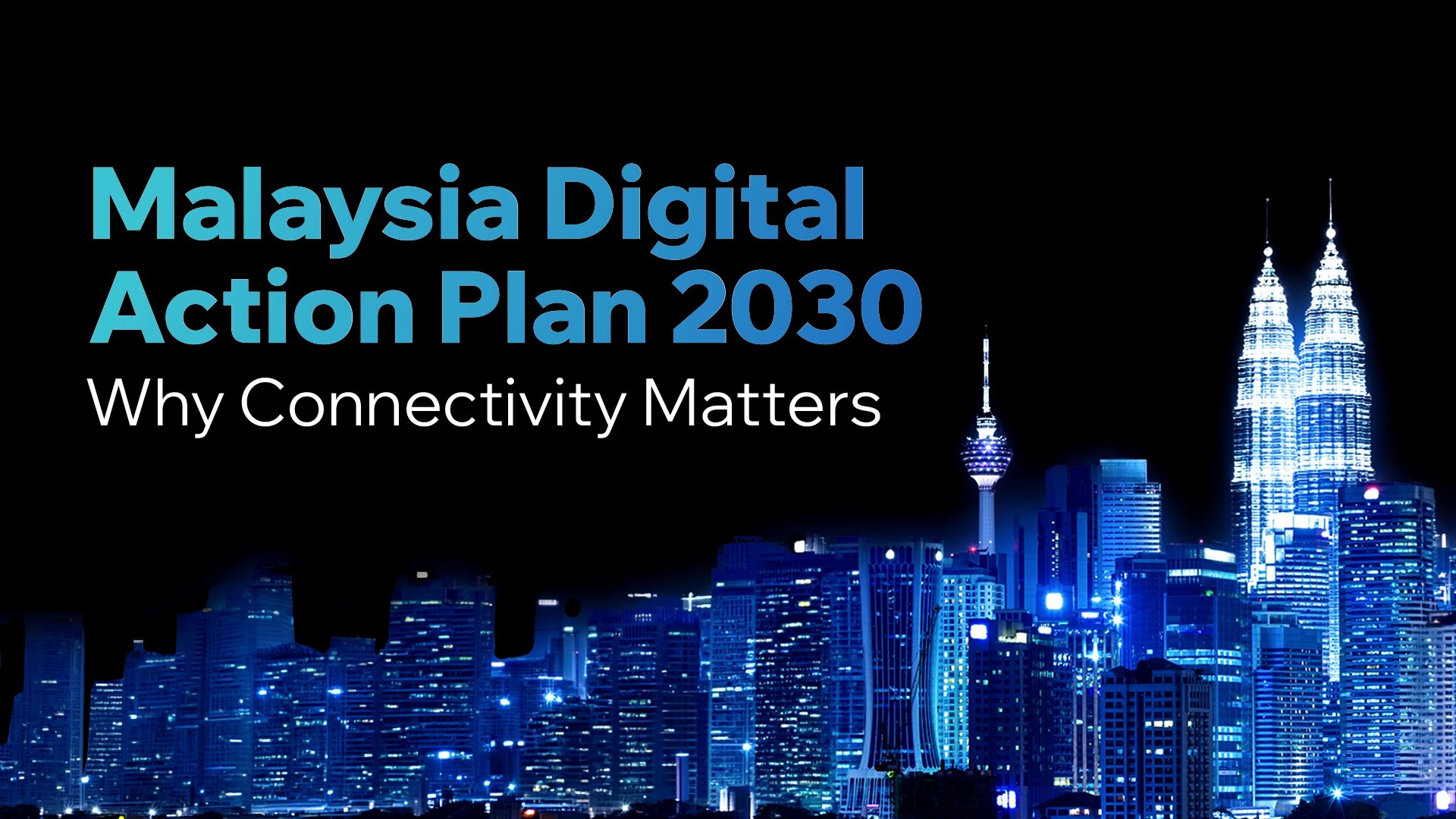
Malaysia Digital Action Plan 2030: Why Connectivity Matters 

Malaysia Digital Action Plan 2030 (MD2030) is setting a clear direction for the nation’s digital economy. Specifically, it places artificial intelligence (AI), technological innovation, and digital infrastructure at the centre of its ambitions. Launched in June 2026, the plan targets a 30% contribution from the digital economy to national GDP while aiming to create 500,000 high-value digital-economy job opportunities by 2030. However, achieving these ambitious goals requires far more than advanced AI applications and digital talent alone. As modern enterprises deploy massive cloud services, AI workloads, and data-driven applications, Malaysia will also require resilient network infrastructure capable of moving surging volumes of data. Consequently, high-performance connectivity is rapidly becoming an essential pillar of the country’s ongoing digital transformation. What Is Malaysia Digital Action Plan 2030? Malaysia Digital Action Plan 2030 serves as the definitive national implementation framework for the country’s digital agenda from 2026 to 2030. The Ministry of Digital spearheads the initiative, supported by a broad coalition of government agencies and ministries executing programs across diverse sectors. The initiative establishes several core national targets, including a 30% digital-economy GDP contribution, 500,000 high-value tech jobs, RM4.5 billion in public-sector savings through accelerated government digitalisation, and 95% end-to-end online public services. Furthermore, MD2030 is structured around seven strategic thrusts: government, economy, infrastructure, talent, society, trust and security, and innovation. This comprehensive architecture demonstrates that Malaysia’s digital transformation extends far beyond basic software adoption; it encompasses critical physical infrastructure, specialized skills development, robust security, and inclusive economic growth. Why AI Growth Creates New Connectivity Requirements Artificial intelligence fundamentally relies on continuous data streams. As organizations aggressively adopt generative AI, machine learning, and other compute-heavy technologies, they must transfer vast quantities of information seamlessly between users, applications, cloud platforms, and distributed computing environments. Consequently, network performance plays a decisive role in the broader digital infrastructure equation. An enterprise may secure access to powerful computing clusters, but applications will inevitably suffer severe performance bottlenecks if the underlying network fails to deliver adequate capacity, low latency, and absolute reliability. Moreover, modern AI workloads continuously interact with hybrid cloud and data-centre environments. This structural reality creates an urgent demand for advanced networks capable of bridging enterprise branch offices with the robust infrastructure powering those compute loads. In practical terms, Malaysia’s aggressive AI ambitions will generate compounding requirements for scalable connectivity alongside traditional computing and storage capacity. Data Centres and Digital Infrastructure Take Centre Stage Infrastructure stands prominently as one of the seven strategic pillars under the Malaysia Digital Action Plan 2030. The federal government explicitly identifies high-quality internet connectivity and sustainable digital infrastructure—including hyperscale data centres, cloud computing platforms, and smart cities—as top national priorities. This strategic focus matters because data centres represent the core foundation of modern digital services. Cloud applications, enterprise systems, AI frameworks, and digital public utilities all depend heavily on underlying infrastructure capable of processing and transferring data efficiently. As a result, data-centre expansion and telecom network development must progress in tandem. While a data centre provides the physical computing environment, high-performance connectivity links that facility securely to enterprises, public cloud ecosystems, alternative data centres, and end users. For organizations operating across multiple physical sites, this interconnected approach is particularly vital as they distribute workloads while maintaining real-time communication between locations. Kuala Lumpur, Cyberjaya and Johor: Key Connectivity Corridors Malaysia’s digital infrastructure ecosystem spans several critical geographic zones. Kuala Lumpur remains the premier commercial and enterprise hub, while Cyberjaya maintains its established status as a leading technology and R&D ecosystem. Simultaneously, Johor has evolved into a powerhouse for hyper-scale data-centre development. This geographical distribution generates a clear operational requirement: businesses need efficient, low-latency network links bridging these key digital clusters. DCConnect Global has established robust domestic connectivity routes linking Kuala Lumpur, Cyberjaya, and Johor Bahru. These routes are specifically engineered to interconnect vital commercial, technology, and data-centre nodes with enterprise-grade reliability. The broader DCConnect Global network also delivers direct connectivity to major data-centre facilities across Malaysia, including strategic sites in Kulai, Johor Bahru, and Nusajaya. Therefore, organizations planning digital infrastructure deployments in Malaysia should evaluate connectivity as an integrated component of their broader data-centre and cloud strategy rather than treating it as an afterthought. How DCConnect Global Supports Malaysia’s Digital Growth As Malaysia advances steadily toward its 2030 digital milestones, enterprises require agile network infrastructure capable of evolving alongside shifting operational demands. This is especially true for organizations interconnecting data centres, cloud environments, enterprise sites, and regional operations. DCConnect Global delivers seamless connectivity solutions across Southeast Asia with an established presence directly in Malaysia. Its dedicated Malaysian routes connect Kuala Lumpur, Cyberjaya, and Johor Bahru, helping businesses establish secure communication channels between critical digital infrastructure hubs. Furthermore, DCConnect Global provides specialized solutions tailored for data-centre interconnection (DCI), dedicated internet access (DIA), and high-speed cloud integration. Its extensive regional network footprint spans multiple Southeast Asian markets, empowering enterprises to unify distributed operations effortlessly. Preparing Networks for Malaysia’s AI-Driven Future Malaysia Digital Action Plan 2030 establishes a visionary blueprint for national digital acceleration through 2030. However, translating these grand ambitions into daily operational success demands physical infrastructure capable of supporting unprecedented data volumes. Consequently, organizations must carefully weigh multiple network parameters when designing their infrastructure roadmaps, including available bandwidth, latency profiles, path resilience, geographic reach, and on-demand scalability. Furthermore, companies operating across multiple data centres derive immense advantages from interconnecting facilities via dedicated, high-capacity network paths. This proactive approach ensures consistent synchronization across workloads, applications, and branch offices. As enterprise AI adoption scales exponentially, network architecture must be prioritized early in the planning lifecycle for all cloud and AI deployments. Building the Connectivity Foundation for Malaysia’s Digital Future Malaysia Digital Action Plan 2030 represents a monumental push to strengthen the national digital economy and build resilient capabilities for an AI-driven future. Its aggressive targets for GDP contribution, high-value employment, and public sector modernization underscore the profound scope of this transformation. At the same time, the plan’s infrastructure focus confirms that long-term digital success relies entirely on high-quality connectivity, advanced data centres, and flexible


Blog

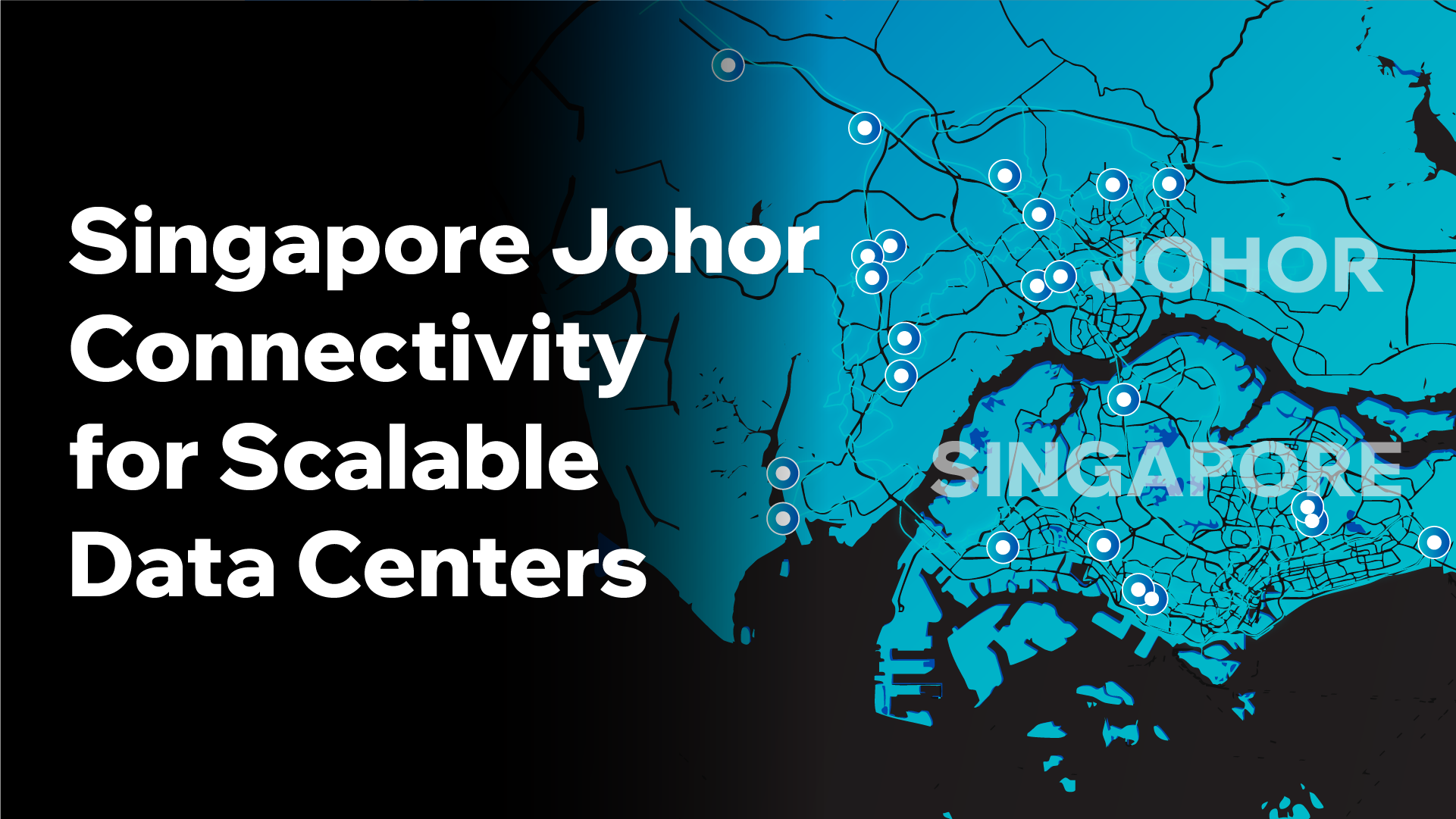
Singapore Johor Connectivity for Scalable Data Centers 

As Johor’s data center corridor expands alongside the Johor-Singapore Special Economic Zone, enterprises need more than a basic connection. They need Singapore Johor connectivity that can scale with demand, flex across providers, and avoid becoming a single point of failure.  For businesses expanding their digital infrastructure across the border, reliable connectivity is becoming a critical part of the data center strategy. Furthermore, the growing concentration of data centers in Johor creates new opportunities for enterprises that need high-capacity links between Singapore and Malaysia.  DCConnect provides flexible, carrier-neutral bandwidth capacity between Johor and Singapore, giving enterprises direct access to the region’s growing data center ecosystem without requiring them to build and manage the underlying network infrastructure themselves.  Why Singapore Johor Connectivity Matters  Johor’s emergence as a major data center destination is closely connected to its proximity to Singapore. As enterprises deploy workloads across both markets, they increasingly need connectivity that can move data efficiently between facilities, cloud environments, and business operations.  The Johor-Singapore Special Economic Zone further strengthens this cross-border ecosystem by supporting deeper economic and digital integration. As a result, enterprises need network capacity that can support growth today while remaining flexible enough for future requirements.  However, simply having a connection between the two locations is not enough. Enterprises must also consider carrier diversity, redundancy, scalability, service reliability, and the speed at which additional capacity can be provisioned.  Carrier-Neutral Flexibility Across Johor and Singapore  Traditional connectivity models can leave client dependent on a single telecommunications provider. That approach can make it harder to adapt when capacity requirements change or when businesses need to introduce additional network providers.  DCConnect takes a carrier-neutral approach to Singapore Johor connectivity.  Instead of locking your infrastructure into one carrier, you can mix and match capacity across multiple providers. This gives your network team greater flexibility to select connectivity based on capacity, routing, commercial requirements, and evolving business needs.  Moreover, carrier neutrality makes it easier to add or change providers as your requirements develop. Therefore, businesses can build a connectivity strategy around their operational needs rather than around the limitations of a single network.  Built-In Redundancy for Business Continuity  Cross-border connectivity is critical infrastructure. If a single network path becomes unavailable, the resulting disruption can affect applications, data flows, cloud workloads, and business operations.  DCConnect supports redundant connectivity options between Johor and Singapore. If one carrier path experiences an outage, traffic can be rerouted through alternative paths, helping businesses maintain continuity.  This approach reduces dependency on a single route or provider. In turn, enterprises can build a more resilient network architecture without having to independently coordinate and manage every underlying carrier connection.  Direct Access to Leading Data Centers  The growing Johor data center ecosystem gives enterprises more options for deploying infrastructure closer to customers, partners, and regional workloads.  Nevertheless, connecting multiple facilities across borders can introduce additional infrastructure and operational complexity.  DCConnect simplifies this process by providing access to leading carrier-neutral data centers across the Johor-Singapore corridor. Enterprises can connect to the facilities they need without building or managing the physical network infrastructure themselves.  As a result, network teams can focus on applications, workloads, and business requirements while DCConnect handles the connectivity layer.  Scale Bandwidth from 1G to 100G+  Connectivity requirements rarely remain static.  A business may initially require 1G capacity for a new deployment. As applications expand, additional customers come online, or more workloads move into data centers, that requirement can increase substantially.  DCConnect provides on-demand scalability from 1G to 100G+, allowing enterprises to adjust capacity as their infrastructure grows.  Furthermore, this flexible approach can help businesses avoid overbuilding connectivity at the beginning of a deployment. Instead, they can provision capacity according to current requirements and scale when demand increases.  That flexibility is particularly relevant as Johor’s data center market continues to develop and enterprises assess new deployment opportunities across the Singapore-Malaysia corridor.  SLA-Backed Reliability  For mission-critical workloads, connectivity performance needs to be measurable and supported by clear service commitments.  DCConnect provides a 99.99% uptime commitment, giving enterprises an SLA-backed foundation for their cross-border connectivity requirements.  Combined with carrier-neutral options and redundant paths, this provides a more structured approach to building resilient connectivity between Singapore and Johor.  Therefore, businesses can evaluate cross-border network infrastructure not simply by available bandwidth, but also by reliability, redundancy, and operational flexibility.  Simplified Cross-Border Provisioning  Building cross-border connectivity independently can involve multiple carriers, facilities, regulatory considerations, and infrastructure providers.  That complexity can increase deployment time and place additional demands on internal network teams.  DCConnect simplifies the provisioning process by providing a single connectivity layer across the Johor-Singapore corridor. This can help enterprises achieve faster turnaround while reducing the operational and regulatory friction associated with coordinating multiple infrastructure providers.  Consequently, businesses can establish connectivity between key data center locations without having to manage every element of the underlying deployment themselves.  Building Connectivity That Grows With Johor  Johor’s position within the wider Singapore-Malaysia digital infrastructure ecosystem is creating new opportunities for enterprises, cloud providers, data-intensive businesses, and digital services.  However, infrastructure growth also creates a need for connectivity that can keep pace.  The right Singapore Johor connectivity strategy should provide more than bandwidth. It should give enterprises the flexibility to work across carriers, the resilience to avoid single points of failure, the capacity to scale from 1G to 100G+, and the reliability required for business-critical workloads.  DCConnect brings these capabilities together through flexible, carrier-neutral connectivity between Johor and Singapore.  As enterprises expand their presence across the region, DCConnect provides the connectivity foundation needed to connect to leading data centers, scale capacity on demand, and simplify cross-border infrastructure — without the infrastructure headaches. Contact us for details at marketing@dcconnectglobal.com 

Vera
Blog

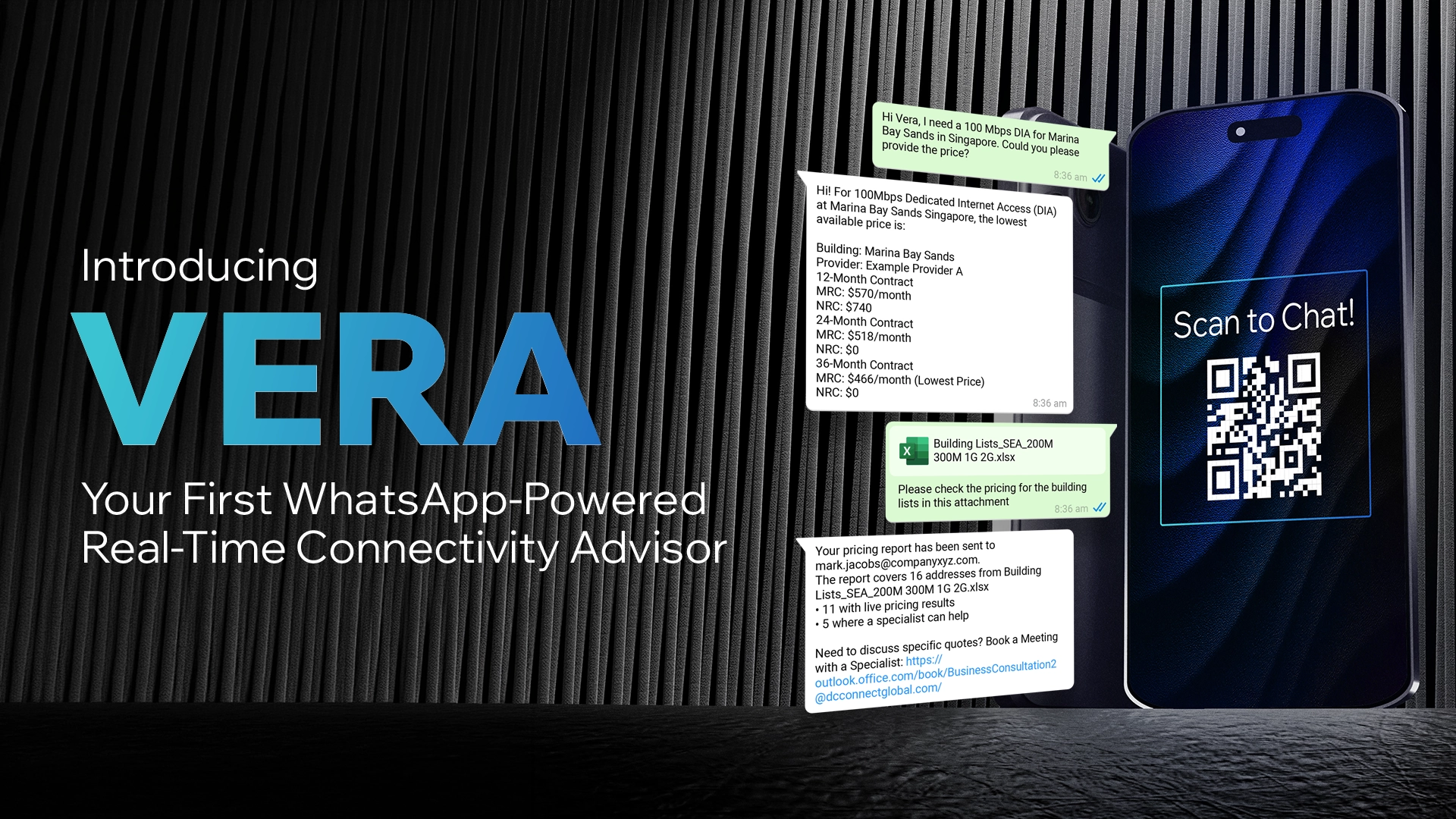
Introducing VERA: Your First WhatsApp-Powered Real-Time Connectivity Advisor 

If you’ve ever bought wholesale connectivity, you know the process. You need a quote, so you send an email or make a call. Then you wait. A day passes. Sometimes two. Sometimes three.  Eventually, a PDF lands in your inbox. It looks different from every other quote you’ve received, making comparisons difficult. You request a revision, and the waiting starts all over again.  For an industry that powers cloud computing, financial services, media platforms, and enterprise networks worldwide, the buying process has remained surprisingly manual. Wholesale connectivity, whether it’s international fibre routes, data centre interconnection, or Dedicated Internet Access—has relied on emails, spreadsheets, and back-and-forth conversations for decades.  The technology evolved. The buying experience didn’t.  Until now.  Meet VERA  DCConnect Global set out to solve one of the industry’s oldest pain points. The result is VERA, an AI-powered Connectivity Advisor that lives inside WhatsApp. Instead of waiting days for a quotation, buyers can simply send a message. Need pricing for a fibre route? Ask VERA. Need a 10 Gbps point-to-point connection between Singapore and Kuala Lumpur? Ask VERA. Need pricing for 40 locations across Southeast Asia? Upload a spreadsheet, and VERA processes every location in minutes. Just verified connectivity pricing delivered instantly through an app that billions of people already use every day Smarter Conversations, Better Decisions  VERA doesn’t just provide prices. She enables better conversations.  Buyers can instantly ask follow-up questions such as:  Because answers arrive immediately, buyers can explore more options, compare scenarios, and make more informed decisions without waiting days between every question.  The result isn’t just faster procurement. It’s smarter procurement.  A Competitive Advantage for DCConnect Global  As a mid-sized telecommunications provider, DCConnect competes with some of the world’s largest carriers—companies with extensive sales teams and decades of market presence.  VERA helps level the playing field.  By providing expert pricing guidance 24/7 through WhatsApp, DCConnect removes the traditional friction that often benefits larger incumbents.  Whether it’s a procurement team in Europe exploring Southeast Asian connectivity or a network engineer in Jakarta requesting a late-night quote, VERA is available instantly.  Final Thoughts  Wholesale connectivity may be invisible to most people, but it powers nearly every digital experience we rely on—from cloud services and financial transactions to enterprise applications and global communications.  Yet the process of buying that connectivity has remained stubbornly manual. VERA changes that.  By combining AI, real-time pricing, and the familiarity of WhatsApp, DCConnect Global has reimagined how connectivity is bought and sold.  It’s not AI for the sake of AI.  It’s AI solving a real problem for real people, and that’s what innovation should look like.