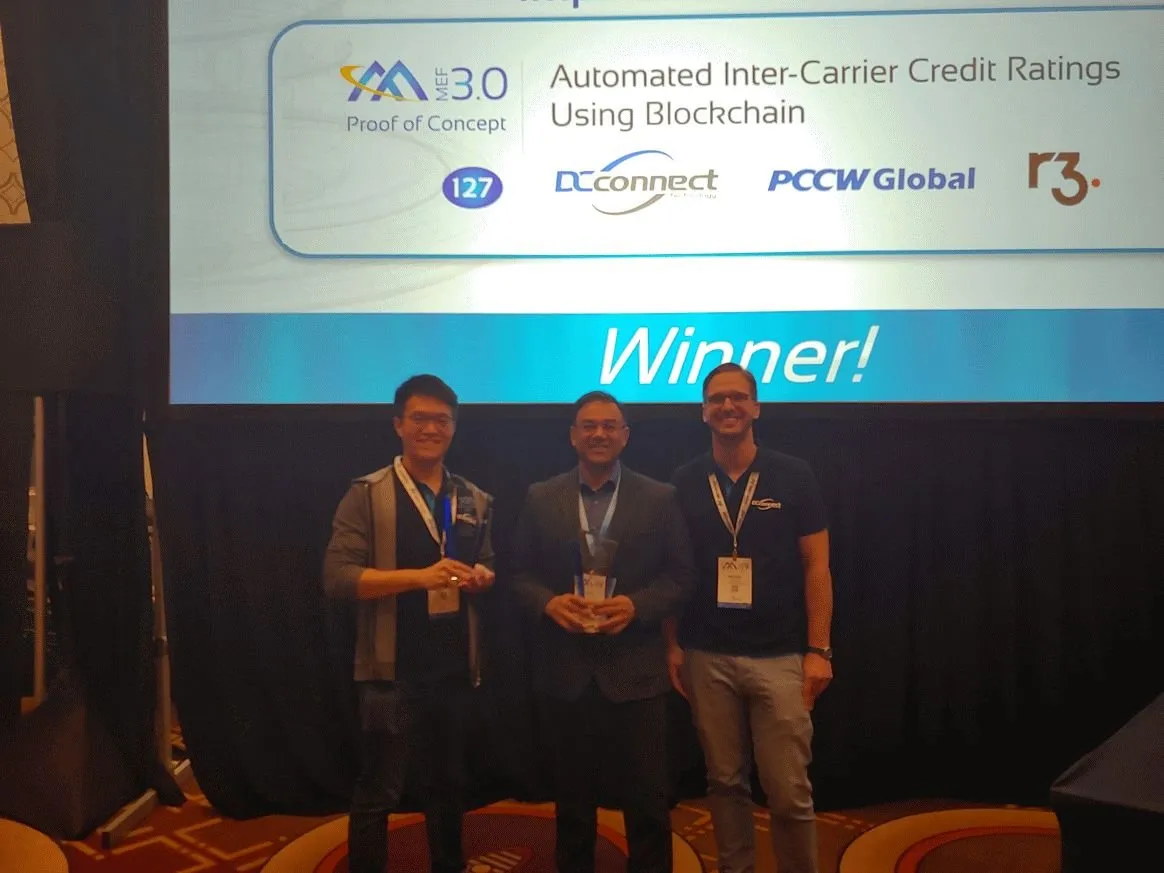
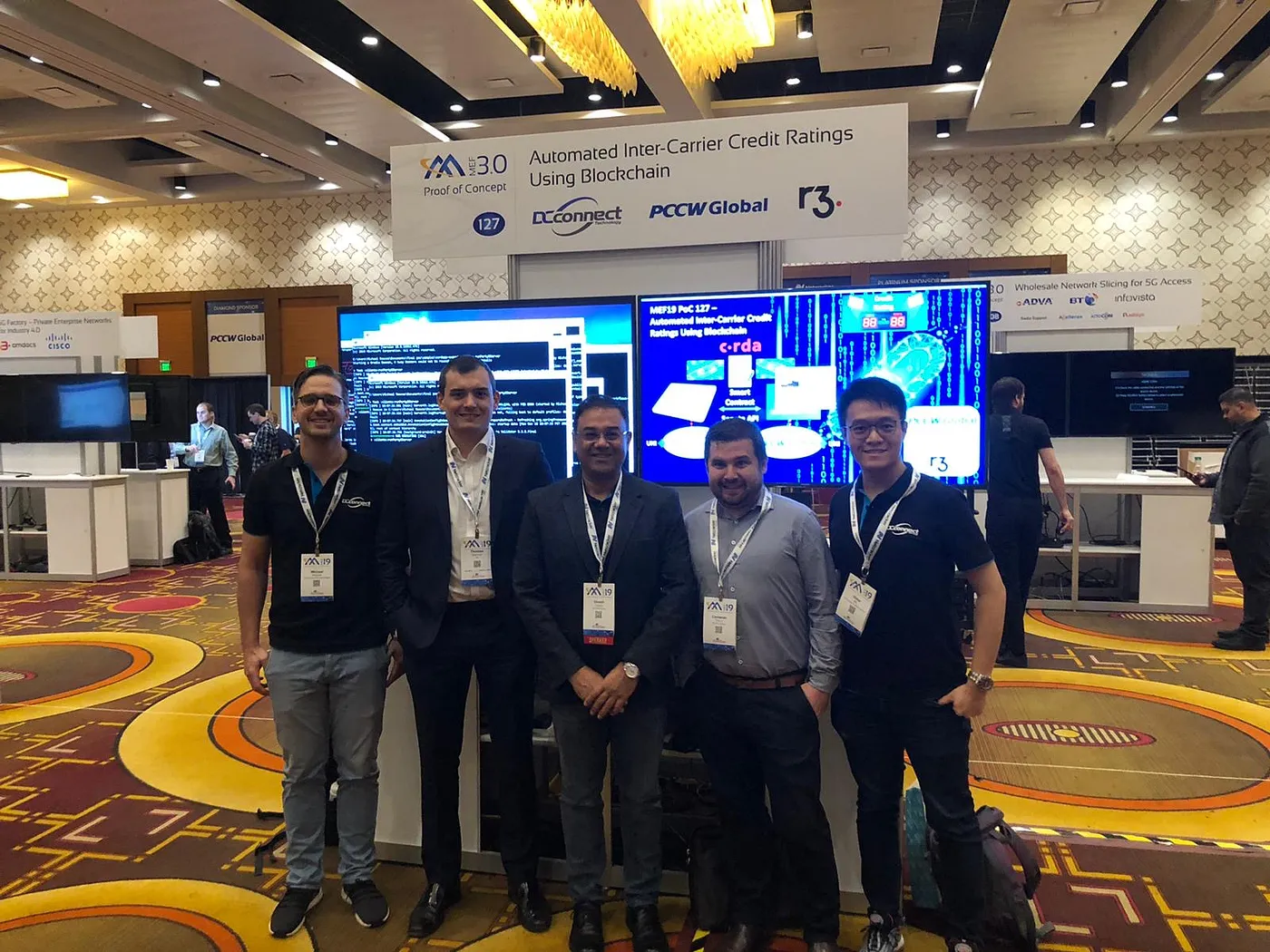
Telcos, the API Economy and Blockchain Victor Ma, Head of Alliance & Market Development, DCConnect Global Ltd. September, 12 2019 MEF’s LSO (Lifecycle Service Orchestration) reference architecture empowers service providers with the blueprint they need to successfully transform their information technology & communications to address the digital economy. It provides the touch-points, related standards, and APIs, to support automation throughout their BSS/OSS—from enterprise subscriber through to the underlying network infrastructure, across transit and access partners, to the cloud. Far-reaching progress was made by MEF in June 2019 with the announcement of the LSO Sonata SDK Release 3 , which provides a set of standard open APIs for serviceability, quoting, product inventory, and ordering. Initially specifically targeting MEF 3.0 Carrier Ethernet services, LSO Sonata SDK establishes the framework for inter-provider service automation of all MEF 3.0 services including IP and SD-WAN services. An important component of business-to-business automation includes the ability to assess the capability of potential partners to deliver a network service, based on their reputation and past history—quickly and automatically. Technologies like blockchain, coupled with LSO standard APIs, create powerful opportunities to enhance these capabilities. To gain further insight on these opportunities, Daniel Bar-Lev, Director Office of the CTO, MEF discussed the topic with Victor Ma, Head of Alliance & Market Development at DCConnect Global Ltd. We chatted about his company’s participation in the MEF 3.0 Proof of Concept (PoC) ‘Inter-Carrier Credit Rating using Smart Contracts and Blockchain’ project to be showcased at the MEF19 event, 18-22 November 2019, in Los Angeles. Interview DBL: Victor, first, please tell us about DCConnect. VM: DCConnect has implemented what we consider to be the first truly fully meshed architecture SDN network fabric, connecting over 120 PoPs in China. We also provide a User Interface Customer Portal, which empowers our customers to control their bandwidth requirements via on-demand technology and the ability to change service parameters like bandwidth within seconds. DBL: What’s the significance of this PoC? VM: Carriers are increasingly automating their inter-carrier commercial and business operations in order to offer agile, assured services. The recent announcements around LSO Sonata Pre-Order and Order APIs are good examples of that. However, the next stage is to offer wholesale operators the ability to build a proven reputation that distinguishes them from their competitors. For example, measuring the very important parameter—How long does it take the operator to deliver their wholesale Carrier Ethernet service once it is ordered via LSO Sonata? DBL: In other words, it’s not enough to reduce service delivery time through automation from months to minutes—the wholesale operator needs a way to show they can do it consistently. VM: Exactly. DBL: So how is this achieved in this MEF 3.0 PoC? VM: We show a standard use case of an E-Line service provider—in this case, DCConnect—ordering a wholesale Access E-Line service from a wholesale operator partner— – in this case, PCCW Global— – using LSO Sonata APIs. As part of the Service Level Agreement between DCConnect and PCCW Global, we have a parameter stipulating the Access E-Line service delivery time from the moment of DCConnect’s order being made. The completion time is then recorded on a Corda blockchain developed by R3. This is then used to update PCCW Global’s credit rating on the blockchain. The higher the credit rating, the more reliable an Access E-Line wholesale partner PCCW Global is considered. DBL: Why is PCCW Global’s credit rating important to DCConnect in this example? VM: Credit ratings help build trust between carriers, which becomes increasingly important when service providers like DCConnect have automated systems that need to choose between wholesale partners within minutes. Having a high credit rating helps DCConnect’s systems select a partner for a specific service much more quickly and reliably. DBL: Is blockchain an essential technology for Credit Ratings between carriers? VM: For a scalable solution—yes, Distributed Ledger Technology (DLT) is essential. Blockchain is a subset of DLT but we tend to use the term blockchain as shorthand for DLT since it’s still more recognizable. The reason DLT is necessary for scalable solutions is that the data for many transactions that impact a carrier’s credit ratings needs to be recorded somewhere, securely, and in a way that the carriers trust. The introduction of DLTs—for example R3’s Corda—into the market enables that in a way that wasn’t possible before. DBL: What happens when a wholesale operator doesn’t meet the service delivery time promised in the SLA? VM: We call this an ‘exception’, and that exception triggers the issuance of a Smart Contract by the service provider-buyer. The Smart Contract captures the actions resulting from the exception as defined in the SLA. One of those actions is for the wholesale operator’s credit rating to be recalculated on the DLT in an automated way as per a pre-agreed formula. The credit rating can go up as well as down, of course. If the wholesale operator delivers a wholesale Carrier Ethernet service to different customers within the specified timeframe consistently—for example 5 times consecutively—then the credit rating could be bumped up. DBL: Who gets to see the Credit Rating of a given wholesale operator on the blockchain? Can it be tampered with? VM: Visibility of information like credit ratings is agreed in advance by the users of the blockchain and programmed into it. Tampering with information on the blockchain is made extremely difficult through a range of inherent characteristics of blockchains. DBL: From DCConnect’s point-of-view, what would you like to see happen as the result of this MEF 3.0 PoC? VM: DCConnect is firmly committed to the ‘API economy’. We believe that exposure of service capabilities between service providers themselves, and of course to enterprise customers, is absolutely essential in order to be able to deliver on the promise of the digital economy. That means we need as many partners as possible that support standardized interfacing, smart contracts, and DLT-based trust models. What we demonstrate in this PoC with PCCW Global is a bilateral example, but this approach is actually multilateral. Standardized blockchain-based telco platforms supporting hundreds, if not thousands, of carrier partners